Part of the fun of drinking cocktails is tapping into a history and a culture of a particular time. This is a discussion of drinks, spirits, bartending, and history for beginners and professionals alike.
Follow me on Twitter for more! @RhettAWilliams
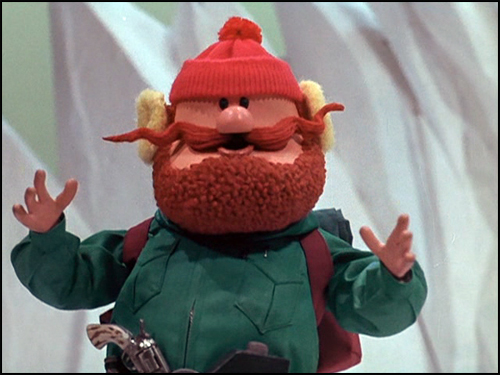
Last week Veneto shared their "Rockefeller" - a Manhattan with chai-spiced whiskey. Bar manager Simon Ogden has contributed another tasty winter drink, again employing the infused rye. This nog finds its name from the 1964 holiday stop-motion classic, "Rudolph: The Red-Nosed Reindeer." In the film, Rudolph meets the self-proclaimed "greatest prospector in the north," Yukon Cornelius, who eventually finds what he's spent his whole life seeking: the legendary peppermint mine. This drink is brimming with Christmas flavours, and is an excellent reason to make a chestnut syrup, which makes for some festive baking as well as cocktails.
The Yukon Cornelius
2 oz Chai spice-infused rye whiskey
1/2oz chestnut-infused syrup
A whisper of Menthe Pastille mint liqueur
1 whole egg
Dry shake all ingredients together, then shake briskly with ice and strain.
Finish with a little fresh-grated nutmeg and cinnamon bark.
Eggnog, the most popular of seasonal drinks, has a clouded history likely due to its old age. It is believed to have derived from the English "posset," a mixture of hot milk curdled with wine or ale and usually spiced that dates back to the fourteenth century. It was prescribed as a cold remedy, and over time became more a drink of leisure, adding egg to the mix and often consumed for breakfast. Milk and eggs, however, were not always easy to come by, and the drink was eventually most popular amongst the higher class. When it was brought to the American colonies where most had their own chickens and cows the drink gained a new popularity. However, the sherry, Madeira wine, or brandy that were traditionally added were scarce or highly taxed, so naturally the Americans added rum instead, which was about as easy and cheap to find as water at the time.
The name "eggnog" has several possible origins, one being simply a simplification of "egg and grog," or "egg'n'grog." Grog was a watered-down rum consumed by sailors in the 17th century. The water taken on-board ships at the time spoiled over time in the sea-soaked barrels, and the rum rations (and earlier ale or wine) were used to mask the terrible taste and conversely to reduce the sailors' intoxication levels. Citrus juice was often added to the mix to combat scurvy. Adding egg to a rum and water mixture could be described as "egg and grog," leading eventually to the drink's modern name.
The suffix "nog," at one point also referred to a strong ale, which could have benefited from the addition of an egg at mealtime or wintertime, leading to "egg and nog."
The more accepted origin of the name is from the word "noggin," referring to a small wooden mug that was often used in taverns to serve drinks at tables (while drinks served near the fire used "tankards"). An egg drink served in a noggin could easily be compounded to "eggnog."
Regardless of the origins, eggnog as we know it today became a staple of American drinking culture, particularly in the colder months likely due to the drink's hearty nature. It was often consumed in a punch style, with copious amounts of sugar, cream, and booze, while being left out at room temperature for days. Making such a drink in warmer weather would have made for faster (or more unbearable) spoilage, which is likely another reason it became a winter drink. Everyone had a good recipe, including George Washington (a particularly boozy one), and by the mid 19th century when Jerry Thomas published his fundamental cocktail book, "How To Mix Drinks," eggnog had become optionally a single-glass drink. Below are two of the most classic of nog recipes, Thomas' single serving Egg Nogg, and his recipe for the drink he claims to have created (though it was later proved actually preceded his birth), Tom & Jerry. I have also included the recipe we use at Pourhouse, where we try to approximate as many drinks as possible to the style and mentality of the Golden Age (1850's-1920's). This recipe is essentially the same, but with less milk and slightly less liquor.
In the coming weeks I will be sharing some modern nog recipes as well, so stay tuned.
Egg Nogg (Jerry Thomas, 1862) 1 table-spoonful of fine white sugar, dissolved with 1 table-spoonful cold water 1 egg 1 wine-glass of Cognac brandy [2oz] 1/2 wine-glass of Santa Cruz rum [1oz] 1/2 tumblerfull of milk [3oz]
Fill the tumbler 1/4 full with shaved ice, shake the ingredients until they are thoroughly mixed together, and grate a little nutmeg on top. Every well ordered bar has a tin egg-nogg "shaker" which is a great aid in mixing this beverage.
Tom & Jerry (Jerry Thomas, 1862) 5lbs sugar 12 eggs 1/2 small glass of Jamaica rum [1oz] 1&1/2 tea-spoonful of ground cinnamon 1/2 tea-spoonful of ground cloves 1/2 tea-spoonful of ground allspice
Beat the whites of the eggs to a stiff froth, and the tolks until they are thin as water, then mix together and add the spice and rum; thicken with sugar until the mixture attains the consistence of a light batter. A tea-spoonful of cream of tartar, or about as much carbonate of soa as you can get on a dime, will prevent the sugar from settling to the bottom of the mixture.
To serve: Take a small bar-glass, and to one table-spoonful of the above mixture, add one wine-glass [2oz] of brandy, and fill the glass with boiling water; grate a little nutmeg on top.
In David Wondrich's "Imbibe," where he lists so many of these classic Jerry Thomas recipes, 2lbs of sugar is suggested instead of 5, because that's a "crazy amount of sugar." Also, he suggests substituting the hot water for hot milk, "as they often did at the turn of the century." My lady is lactose-intolerant, so I make a fair share of this just with water and enjoy it all the same. If you suffer a similar affliction, I also suggest using almond milk, which has a thicker consistency so will give you that nog texture you want. Also, Thomas himself suggests using a mixture of 1/2 brandy, 1/4 Jamaica rum, and 1/4 Santa Cruz rum instead of just straight brandy. I love making my egg nog with a mix of brandy and rum, anywhere from 3:1 to 1:1.
A final note is that this mixture is easily scaled down. I have made some for small parties of 4 by dividing by 6, for example. Experiment and taste as you go along.
Traditional Eggnog (Pourhouse, Vancouver) 2oz rum 1oz 1:1 simple syrup 1oz whipping cream 1 whole egg
Combine ingredients in a shaker with ice and shake hard to thoroughly mix. Strain into an old-fashioned glass and grate some fresh nutmeg over top.
Opening the door to a discussion of mulled wine would result in hours of debate and anecdote, (made all the more difficult if simultaneously consuming said wine). This can be proved simply by listing even a handful of its names and variations: Glühwein, Glögg/Gløgg, vin chaud, greyano vino, izvar, Glintwein, Caribou, Hippocras, Negus, and Feuerzangenbowle. It can have different bases, such as port (called a "Smoking Bishop"), ginger wine and raisins ("Smoking Beadle"), or Champagne ("Smoking Cardinal"). Then there are the mulled ciders, ales, and meads, and the close relation to punch, bringing with it further wealth of history and variation. The number of cultures with a version of this theme is mind-boggling, but the purpose behind the practice is consistently the same.
Before proper storage techniques were invented, food and drink spoiled fairly quickly. One had to be creative to keep food fresh longer or at least to make stale and spoiling food more tolerable (practices that also masked poor-quality products). In Roman times, spices and sugars or honey were added to wines to delay spoilage or mask flavours, typically a practice done in the early winter once the wines harvested in early fall began to stale. This practice dates back to Greece as well, where a wine, spice, and honey mixture called "Hippocras" or "Hypocrace" (supposedly created by Hippocrates as a health tonic) was used and later became popular England for the next thousand years. Other cultures figured out similar strategies for wines and juices and as years passed practical process became tradition.
In Southern England where apples and cider (fermented fruit juice) were an important part of agriculture, a yearly autumn ritual was created sometime before the 11th century called "Wassailing." This was a ceremony celebrated in early January involving drink and song that blessed the health of the trees, scared away evil spirits, and ensured a good harvest for the following autumn. (Wassailing was also a traditional exchange between lords and peasants in the middle ages that encouraged charity, which is the origin of what we consider Christmas Caroling, but has no direct relation to drinking). The drink for this ceremony was aptly named the "Wassail," a heated ale (and later cider) mulled with sugar, cinnamon, ginger, nutmeg, and sometimes fruit, brandy, sherry, and even bread.
By the 18th century, most cultures had a solid tradition and recipe for mulled wine. We will only look at a few of the most popular here: Glühwein and Glögg (pronounced "gloo-vine" and "gluig"). While similar, the differences in alcohol, spice, and garnish are very important to those who carry the tradition. Every town has its own secret recipe, so I am amalgamating the ones I've come across as there are several consistencies. The one thing I don't like in my mulled wine is fruit juice, and this doesn't show up very often save for more modern North American versions. It's not necessary and mutes the spice.
Glühwein(German Mulled Wine, dating to early 15th century) 1 bottle of dry red wine (750ml) 1/2 cup of sugar 1/2 lemon or orange, sliced 10 whole cloves 3-5 cinnamon sticks
Pour the wine into a large pot and add other ingredients. Simmer at low heat (do not boil) for 30-60 minutes and serve. There are MANY options here, including adding some allspice berries, maybe a 1/2 teaspoon of ground nutmeg, and adding some water should you simmer the wine too long or too hot, which will make it thick and syrupy. Serve in warmed mugs, and optionally add an ounce of brandy to make things interesting. Do not add the brandy to the heated mixture as the alcohol will boil off.
(Feuerzangenbowle is a Glühwein that leaves a sugarloaf soaked in rum then set aflame sitting atop the wine, slowly dripping sugar into the mix.)
Glögg (Nordic Mulled Wine dating to early 17th century) 1 bottle of dry red wine 1 bottle of port [2 cups brandy (optionally akvavit or vodka)] 2 cups water 1 peel of orange (the whole orange), cut into strips 10 cardamom pods or about 1/2 tsp of cardamom seeds 10 whole cloves 1/2 cup raisins 1/2 cup blanched almonds 1 cup sugar (or less to taste) 2 cinnamon sticks 3-5 slices of peeled ginger (optional)
Processes consistently differ, with some boiling the brandy with sugar to create a syrup with which to sweeten the mulled wine and port mixture. Myself, I prefer the highest alcohol content and flavour possible in my drinks, so I prefer to add the brandy last to each mug before serving, as with the Glühwein. The 2 cups of brandy above is a measurement if combining it to the wine mixture while heating, but if you choose not to do this as I have, just measure 1-2oz of brandy per mug before serving. Having said that, here the best process: Combine wine, port, water, orange peel, cardamom, cloves, sugar (start with 1/2 cup), cinnamon, and ginger in a pot and simmer at low heat for 10 minutes. Add more sugar to taste. At this point you can optionally let the mixture cool and have it steep in the fridge overnight before reheating to maximize the flavour. For those of you like me who are less patient, keep the mixture at low heat for another 20 minutes or so, being careful not to boil. Prepare 10 mugs by warming them and dishing out about 1tsp of almonds and raisins to each, along with the brandy if not used in the first step. Strain mulled wine into each mug and garnish optionally with a fresh orange zest or whole clove (or better yet, an orange zest with a whole clove stabbed into it).
To be further adventurous, you can soak the almonds and raisins beforehand in a mixture of spice and akvavit. Leave them in a sealed bag or container for at least 24 hours with some cardamom seeds, cloves, and cinnamon, and enough akvavit to ensure they're covered. Even just soaking in the akvavit will extract a surprising amount of flavour from the spirit, which includes caraway, cardamom, cumin, anise, fennel, and citrus. For anyone not accustomed the flavour of this spirit, soaking the raisins and nuts and adding them to the mug when served is a subtle and fancy addition of the flavour.
Mulled cider is another very common and fitting winter drink (and is synonymous with Wassail today). I feel it would be redundant to list a recipe here. Following either of the above mulled wine recipes or variations thereof would work just fine if cider is substituted for the wine and the sugar is omitted. For all three drinks, other spices that would make great additions include a little nutmeg, whole star anise, allspice berries, and a few slices of citrus. Broken cinnamon bark can be used in place of cinnamon sticks, though use it more sparingly as it has higher surface area. I again stress that adding the spirit while serving and not while steeping is a better option to ensure full flavour and alcohol.
"The Flip" is one of the earliest recorded mixed drinks, dating back to at least the late 17th century in colonial American taverns. Sugar or molasses, spices, and rum were added to a large bowl of beer, a practice likely derived from masking or delaying spoilage similar to mulling wine. A red hot loggerhead, or fire poker, was inserted into the mixture, causing it to froth and the sugar to caramelize - a process called "flipping." As far as is known the recipe remained unchanged until the mid-19th century, listed in Jerry Thomas' seminal tome "How To Mix Drinks" (1862). Here warmed ale and a mixture of eggs, sugar, rum or brandy, and ground nutmeg, ginger, and lemon peel are tossed between pitchers until smooth (perhaps another origin of the name "flip"). Likely due to the streamlining of this time-intensive process, the Flip (like the Punch before it) evolved into a single-glass drink and the hot temperature became optional. In Thomas' 1887 revision of his book he included seven cold and six hot Flips, each listed simply as a liquor with egg, sugar, and water (hot or ice), topped with freshly ground nutmeg.
(A note here that while the modern [meaning 19th century] Flip seems similar to Egg Nog, they differ in one important aspect: milk. Nog contains milk or cream while the Flip does not. It was often made in a punch bowl, but like the Flip it did have a by-the-glass recipe as well. More on Nog later this month.)
Flips have evolved into a whole range of uniquely satisfying drinks, and I will be sharing some modern ones soon. For now I'll share Jerry Thomas' 1887 recipes for both a Hot and Cold Flip, and then his Hot English Flip of old.
Hot Flip(Jerry Thomas, 1887) 1 tsp sugar
1 wine-glass liquor (2oz)
Yolk of one egg
Dissolve the sugar in a little hot water, add the brandy and egg, shake up thoroughly. Pour into a
medium bar-glass and fill it one-half full of boiling water. Grate a little nutmeg on top, and serve.
Here, many liquors are possible. Thomas listed brandy, rum, Holland gin, and whiskey, but feel free to experiment. For the sugar, you can replace it with the same amount of 2:1 simple syrup, or twice the amount of 1:1.
Cold Flip(Jerry Thomas, 1887)
1 tsp powdered sugar
1 wine-glass of liquor (2oz)
A little water
1 fresh egg
2-3 lumps of ice
Dissolve the sugar in the water, add the liquor,
egg, and ice, shake up thoroughly. Strain into a small
bar-glass. Grate a little nutmeg on top, serve.
Thomas here listed brandy, rum, Holland gin, whiskey, port, and sherry. When shaking a Cold Flip, ensure you shake long and hard to really emulsify the egg. See above for replacing sugar with simple syrup.
Lastly, here is the original Flip using ale and rum.
Hot English Rum Flip(Jerry Thomas, 1887)
1 quart of ale
1 gill of old rum (4oz)
4 raw fresh eggs
4oz of moist sugar
1 tsp of grated nutmeg (or ginger)
Heat the ale in a saucepan ; beat up the eggs and
sugar, add the nutmeg and rum, and put it all in a
pitcher. When the ale is near to a boil, put it in
another pitcher, pour it very gradually in the pitcher
containing the eggs, etc, stirring all the while very
briskly to prevent the eggs from curdling, then pour
the contents of the two pitchers from one to the other
until the mixture is as smooth as cream.
To make a "Hot English Ale Flip," simply omit the rum and two of the eggs.
[[Photograph from "Stagecoach and Tavern Days" by Alice Morse Earle, 1900]]
Mixing drinks is a very, very old practice, but it wasn't until the mid 19th century that these mixtures started to resemble what we call "cocktails" today. In fact, a "Cock Tail" was a kind of mixed drink at the time, containing just a spirit, water, sugar, and bitters (which today is called an "Old-Fashioned," referring to serving a cocktail the "old-fashioned way"). Going back further there are the Toddy, the Julep, the Sangaree, and the Sling, all of which were almost exactly the same thing, leading to some confusion down the line.
(I am of course avoiding Punches here, which are even older and range from just as simple to much more complicated. The Sour and the Fizz and the Collins, etc, are all descendents of Punch).
A "Cock Tail," in its original definition, was first referred to as a "Bittered Sling." Let's back up and look specifically at the Sling.
The definitive knowledge on these 19th century drinks is from the grandfather of bartending, Jerry Thomas. He wrote the first tome on bartending and mixed drinks in 1862, which included a collection of Punches as well as each of the above mentioned cock-tail precursors. The Toddy and The Sling (likely named after "slinging one back") are essentially separated only by temperature - a Toddy was usually served hot, and a Sling was usually served cold (though you could get a Cold Toddy and a Hot Sling, so again - confusion). In his first book he including a scrape or two of nutmeg over the Sling, while the Toddy was without, but in the second edition in 1887 removed this distinction. The Gin Sling, dating to about 1800, became a staple in American drinking, even commonly being consumed first thing in the morning. As always, alcoholic mixtures were considered medicinal, but it quickly surpassed this use and became wildly popular in every corner of the country. Adding further to its popularity was the increased availability of ice around the 1830's, making cold drinks more common, and drinking in general a little more accessible (room temperature drinks are definitely not as palatable).
Gin was the most popular of Slings, but you can of course use any spirit (Cognac and rye would have been common as well). At the time, Holland-style gin would have been the kind used, and not London Dry like we're used to today. It's hard to find, though David Wondrich offers a very simple suggestion to recreate it in his fantastic and inspiring book (from which I am getting much of the information in this post) - simply mix 60% Plymouth gin with 40% Irish Whiskey. (Irish Whiskey and Holland gin / genever are actually related and have taste similarities). He does also offer another suggestion in that spirits back than were typically higher proof, and thus a Sling required a little more water than nowadays. Decreases the 1oz to 0.5oz is a good idea if you're using an 80-proof.
Here is the recipe from Jerry Thomas' first edition for the original Sling:
2oz of spirits 1oz of water 1 teaspoonful of powdered white sugar (which equates to about 1/2oz of 1:1 simple syrup) 1 small lump of ice
Stir with a spoon. [Grate some nutmeg over top]
In the 1862, Queen Victoria's Chef, Charles Elme Francatelli, published his own book including a very different Sling using juice and some liqueur, which by 1915 had spawned the Singapore Sling, using Gin Cheery Heering Cointreau Benedictine Grenadine Pineapple Lemon and Angostura bitters.
Quite the change. Its popularity unfortunately brought the demise of the traditional Sling, and now if you order a Gin Sling you will typically receive the following: Gin Sweet vermouth Lemon juice Sugar Angostura bitters Soda
Just like most classic drinks, including the Cock Tail, variations and creativity were the death of tradition. Of course, without variation, we'd have nothing we do today - including even the Cock Tail itself, which as I mentioned is simply a Bittered Sling.
When asked to contribute some writing about the Vancouver cocktail
scene to ShakeStir, I figured the best way to begin is, well, at the
beginning. My beautiful city of course has its history of saloons and
beer halls, and yes, Canada even had a Prohibition, which was different
for each province, and thankfully ended in British Columbia in 1921
after being a complete disaster and lasting only four years. This year
brought about extremely strict government regulations, many of which
are still frustratingly in place today. For example, it's only
relatively recently that credit cards can be used in a liquor store,
that non-government liquor stores have been allowed to exist, and that
one can order a drink without ordering a meal. The archaic system by
which we distribute liquor in the province is why it's so expensive,
and sometimes impossible, to get so many good products. I digress. This
being a cocktail site, I went back as far as I could to find original
Vancouver cocktails, and only came up with two - both from the 1950's.
We begin with "The Hotel Georgia."
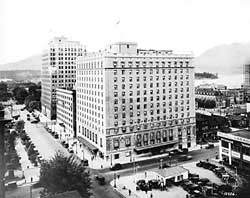
Built in 1927 in the heart of downtown Vancouver, The Hotel Georgia
was the swankiest spot in the city, and housed many famous guests over
the years, particularly in the music scene as Hornby Street half a block
away was home to all the top music clubs in town. Elvis Presley, Louis
Armstrong, Nat King Cole, and The Rat Pack were just some of the
guests through to the 1960's, around the time that Vancouver stopped
being part of the regular big tour schedule for major artists. The
Hotel Georgia was also the only hotel in Vancouver at the time that
allowed people of both "colours" to stay, mingle, and yes, even drink
together in the same bar, making it home in particular to The Rat Pack
every time they toured here.
Vancouver in the 1950's was a haven of jazz and burlesque, particularly at the top club in the city, The Cave,
which was the first to be granted a legal liquor license. The shows
were famously elaborate and Vancouver crowds were famously difficult to
arouse. Las Vegas showgirl productions were actually audience-tested
first at The Cave before being brought to the strip. Another connection
to Las Vegas that many don't realize is that Vancouver was actually
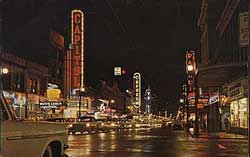
the "Neon City" first, and in 1953 had over 19,000 neon signs before
city laws prohibited their use in the 1960's. That many lights
reflecting off rain-soaked streets was a much talked-about sight to
see. Famous jazz acts always passed through Vancouver and played with
The Cave's house band, and many also played inside The Hotel Georgia
itself, which until 1941 was also home to a music radio station that
broadcast from the top floor live shows that were happening in the jazz
clubs downstairs.
Let's fast forward again, when The Hotel Georgia was closed in 2006 for renovations, then finally reopened in 2011 as the Rosewood Hotel Georgia,
and I can easily say that it is one of the coolest places in the city.
Aside from its beautiful design, including historic mahogany walls and
marble flooring in the lobby, and one of the country's largest private
collections of Canadian art, it has three (soon to be four) places to
drink. The 1927 Lobby Lounge,
the manager of which was the late Derek Vanderheide, is a well-stocked
and well-staffed bar sitting up a few steps in the corner of the
lobby, offering sophisticated drinks and high-end spirits. Reflections
is a patio lounge on the fourth floor of the hotel with cabanas, fire
pits, views of the city skyline, and a much more summer-friendly drink
list. Later this year, a music and dance club called Prohibition will
be opening in the basement of the hotel, featuring a lot of jazz and
another craft cocktail bar, both in honour of the hotel's 1920's roots.
Lastly, Hawksworth Bar & Lounge, recently cleaning up at the Vancouver Magazine Awards
winning multiple restaurant and bar awards, is the flagship of the
hotel with amazing food, and a very solid bar program run by Brad
Stanton, Vice-President of the Canadian Professional Bartender's Association.
The menu has some very solid, creative but simple originals, and a
selection of classics as chosen by each of the bar staff by name. The
spirit selection is great here as well, even featuring a handful of
mezcals, which is happening more now in Vancouver but was previously
unheard of and is still uncommon. If you find even 10 minutes to stop
by, the menu features small-sized house aperitifs and digestifs that
are perfect for starting or finishing your evening.
On to the cocktail!
The Hotel Georgia cocktail is speculated to have been created at the
hotel itself in the 1940's, but it isn't until 1951 that it is first
mentioned in print, in Ted Saucier's book, "Bottom's Up"
a fun, and very dense collection of over 200 cocktails along with some
risqué illustrations. The book is home to a lot of bad drinks, a lot
of celebrity drinks, a few really great classics, including The Last Word, and a few forgotten gems, like The Hotel Georgia (complete with a sketch of a naked woman).
The 1951 version is much too sweet and perfume-y, which likely has a
lot to do with what the ingredients were like at the time, using 2
ounces of gin, 1 FULL ounce of orgeat, ½ ounce of lemon juice, 10 drops
of orange blossom water, and an egg white. I made this at home and
could barely handle how sweet it is. Brad altered the recipe for
today's tastes, reducing the orange blossom and orgeat, increasing the
lemon, and choosing specifically Plymouth gin, "resulting in a silky,
stimulating and balanced beauty of a drink to be true to the light,
floral, and elegant style of the original." The garnish is what really
sold Brad's version to me, as the spice of the nutmeg on your nose as
you sip really cuts down the sweetness. It makes an excellent dessert
cocktail at home, but if there are any bartenders reading this thinking
of making it at your own bar, there is a new tradition: if you make a
Hotel Georgia, you must serve it on a Hawksworth Hotel Georgia coaster,
so ask for one and make it properly!
The Hotel Georgia
1.75 oz Plymouth Gin
0.75 oz lemon juice
0.5 oz Giffard orgeat
6 drops A. Monteux orange blossom water
1 egg white
Nutmeg
Combine ingredients, beginning with egg white, and dry shake. Add
ice then shake vigorously for about 20 seconds. Double-strain the
mixture into a cocktail glass and grate a little nutmeg onto the surface
of the drink.
To pair with your Hotel Georgia from 1951, I'm going to come back to
the Las Vegas and Rat Pack-Vancouver connections and go with Frank
Sinatra. Specifically, I'm going with one of my favourite drinking songs
(the one after which I in fact named my blog), "One For My Baby, And
One More For The Road," from the 1943 musical, "The Sky's The Limit."
Recorded more times than we can count, Frankie's are my favourites, the
most famous of which is the 1958 one from his extremely sad "Only the
Lonely" album. This one is my favourite overall, but since this drink is
light and sweet, I'm going with his much happier first recording of it
from 1947.
See you at the Hotel Georgia. Enjoy!
Originally published on www.shakestir.com by Rhett Williams
Photography: Hotel Georgia in 1930 by Leonard Frank via Vancouver Archives Granville Street neon circa 1950's courtesy the Vancouver Heritage Society "Bottom's Up" by Ted Saucier Hotel Georgia Cocktail from Hawksworth Restaurant in The Rosewood Hotel Georgia, Vancouver, by Rhett Williams