Showing posts with label cocchi americano. Show all posts

Wednesday, 3 July 2013

Aromatized Wine Classification

By North American standards, vermouth was once a stale, stinky wine collecting dust on the backbar waiting for some weirdo (probably European) to order a wet Martini. This wasn't actually that long ago. Many drinkers (myself included) claimed they hated vermouth without realizing they were most likely ruining drinks with oxidized bottles. Once the interest in classic drinks returned and brought with it the knowledge of product care and desire for those of higher quality, vermouth's reputation began to change. New vermouths were hitting the market and old ones became more available. Furthermore, similar products came into common use, such as Cocchi Americano, Lillet, and Byrrh, to name a few. Despite their much stronger presence today, they still seem to be enigmatic to some. Most drinkers can classify whiskeys, but can they classify vermouth, americano, and quinquina? Even experienced bartenders aren't making the distinction between different types of aromatized wines, so perhaps it's as good a time as any for a little history and classification.

Where did they come from?

The practice of aromatizing wine dates back to at least 400 BC in Greece, the purpose of which was both to mask poor-quality or spoiled wine and to create medicinal tonics, just as most spirits and liqueurs originate. Once distillation became commonplace after the 12th century, wines began to be fortified as well as aromatized - most notably in 16th century Germany, with usually a brandy being used to fortify and wormwood for aromatizing. This herb was believed to cure stomach and intestinal disorders and parasites, and the drink began to include many other herbs and spices and became a cure-all, much like bitters. These "wormwood wines," or "wermut" in German, became popular in England over the next hundred years, and the name became anglicized to "vermouth." Italy and later France took the reins on vermouth production, but by the late 1800's it was not the popular drink it once was - particularly in a medicinal sense thanks to the popularity of bitters. It was around this time that vermouth found its way into early cocktails via two of the most famous mixed drinks known to man: the Manhattan and the Martini.

What about these other kinds of aromatized wines? Wormwood was not the only medicinal herb being infused into wine. Quinine (via South American cinchona bark) and gentian root were also common, along with different combinations of popular ingredients, like cinnamon, cardamom, cloves, coriander, chamomile, and vanilla. So is a vermouth, or "wormwood wine," still a vermouth if it doesn't contain wormwood? Technically, no. Here's where it gets tricky: when absinthe was banned in the early 20th century thanks to the reputation of wormwood, many vermouth producers stopped using the herb as well. This irreparably confused aromatized wine classification for years to come as many of the vermouths we knew and loved didn't contain their title ingredient anymore. Now that the age of anti-absinthe propaganda has passed, wormwood has become common in bartending, but there are still numerous vermouths that use little or none of the herb in maceration. It doesn't help that there are no legal requirements for aromatized wine production, so anything can be added or omitted. This leaves us with history to aid in classification by looking at what the products originally contained in the cases where the recipes have been changed.

How are they made?

"Aromatized" wines are macerated with botanicals to impart both flavour and colour. Depending on the type of botanicals used, these wines are separated into basic categories: quinquinas, americanos, barolo chinatos, vino amari, and vermouths. Fortification is also an important part of this process, meaning that a spirit (usually brandy) is added to the wine at some point during the production process. This will increase alcohol content, and depending on the stage at which the wine is fortified, will also increase sugar content. Wines that are fortified but not aromatized include sherry, port, and madeira. Typically vermouths, americanos, and and quinquinas begin as a white wine or a mistelle, which is when a spirit is added to crushed grapes to produce alcohol rather than using strictly fermentation. These wines are then macerated with botanicals, and in the case of darker coloured aperitifs (such as sweet vermouth) usually coloured with caramel.

How each of these categories are differentiated is mainly by specific botanicals used for maceration. For example, vermouth used wormwood, quinquina used quinine from cinchona bark, and americano (named from “amer,” meaning bitter) used gentian and often wormwood as well.

Below is a chart of the basic types of aromatized wines, including their traditional specifications:
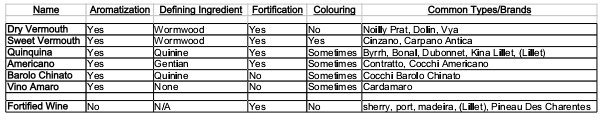


Because of the lack of clarification, some products end up in a sort of limbo between definitions. Lillet is an excellent example. Many bartenders call it a vermouth, but because it does not contain wormwood, it is not a vermouth by traditional definition. More importantly, Lillet is not aromatized, but rather a Bordeaux wine blend (85%) fortified with citrus liqueurs (15%), which themselves have been aromatized. This technically makes Lillet a fortified wine but not an aromatized one. Lillet was originally called Kina Lillet until the recipe was changed in 1987, and did actually contain quinine, so originally Lillet would be considered a quinquina. Today's recipe claims to still contain quinine, but this is neither confirmed nor evident. Cocchi Americano, which is supposedly a good approximation of Kina Lillet, contains gentian as a major component so is considered an americano (hence the name). 

Things are for the most part confusing, so while it is important to know the history and general distinctions between these types of wines, the most important factor is taste. Each of these products have their own place and use and should not always be used interchangeably. Most importantly of all, they are wines and need to be treated as such. They will go off over the course of a few days to a few weeks depending on the product, and should be kept in the fridge if stored.

Next post I will delve deeper into vermouth with more specific history and geography of the major brands.


 [[ originally published on www.shakestir.com by Rhett Williams ]]

Thursday, 7 June 2012

Quinquinas and Americanos


Next is a classification of aromatized wine that isn't really referred to anymore, despite there being several very popular products that fall under its umbrella. Like vermouth, these classifications have blurred, in part due to the limited availability of some of the ingredients used in production, but also likely because people's tastes have changed so much and spirit and wine companies have shifted with that trend.

As mentioned in my post on vermouth, its original ingredients included wormwood, and a separate group of aromatized wines included primarily quinine and were appropriately named "quinquina" (keen-KEEN-ah). Quinine has a decorated history in early medicine dating back to the mid 17th century when Italians used it to cure malaria. Its source is Peruvian bark, Chinchona bark, or "Jesuit's Bark," which was used by indiginous South American people as a medicine. Italians there at the time noticed this and brought it back home where it became common use throughout most of Europe, especially amongst sailors who drank it simply with water. Adding a ration of gin made it more interesting, and a little lime made it more palatable (and also warded off scurvy), and thus is the birth of what we now call the Gin & Tonic. Medicinal tonics, as always, lead to popular social and recreational libations, and the French in particular enjoyed steeping their wines in it along with other herbs. All but one of the well-known quinquinas are French, with Cocchi Americano being Italian (of course it's essentially Kina Lillet, which is French).

"Americano" is actually another classification of these wines ("amer" as in bitter, not America) with a stronger focus on gentian root, and often contained wormwood as well. Americanos and quinquinas are usually grouped together, and I actually can't seem to find any particular product that is clearly defined as just americano. I assume Cocchi Americano is one, but only because of the name, because the flavour does include quinine and it can therefore be considered a quinquina as well.

Chinchona bark, as it is most often called today, is impossible to find in Canada as far as I've found. In a somewhat recent attempt to make my own bitters, I went from herb shop to herb supplier and so forth and none of them carried, none of them knew anyone who carried it, and a handful of them had no idea what I was talking about. So I ended up buying a bag of it for $2.00 at Pike Place Market in Seattle. That's a pretty typical end to most Vancouver stories.

Here are the only brands of quinquina (and americano?) that are available in the U.S. market:

Bonal Gentiane Quina - From St. Laurent du Pont in 1865, featuring quinine and gentian root.

Byrrh - from Thuir in 1866, one of the few fortified and aromatized wines to begin with a red wine base.

Cocchi Americano - originally created in Asti, Italy, in 1891. This is the closest taste you will find to original Lillet (Kina Lillet) since the recipe was changed in 1986.

Dubonnet - from Paris in 1846. The "rouge" is the classic recipe (or so we think), and the "blanc" is a newer American-market invention. After the the 1940's, the Dubonnet available in the American market has actually been made under license in Kentucky, which of course has led to debates on the validity of the product.

Lillet - from the Bordeaux region in 1887. As I mentioned in earlier posts, Lillet isn't really a quinquina anymore since it barely contains quinine - if any - so essentially serves as its own product and classification under the broad umbrella of fortified wines. It is essentially a dessert wine, being a blend of Bordeaux wines fortified with a little orange liqueur, so the proof and sugar contents are higher, but otherwise tastes much more like a wine than a vermouth or anything else. In 1986 the producers removed all or almost all of the quinine as well as the "Kina" in the title. The rouge version has been around since the 1960's, but only recently became more readily available, and a rose should be hitting the market soon. Any classic cocktail calling for "Lillet" should be made with Cocchi Americano as this is the most accurate representation of the flavours intended.

In Canada, you can easily get Dubonnet and Lillet at any decent liquor store, and you can find it for less than the states (yay us!). However, Bonal, Byrrh, and Cocchi are not available at all, and will require a trip down south (and the Cocchi is worth it).

Darker quinquinas (such as Dubonnet or Bonal) can serve in place of sweet vermouth in a cocktail, but balancing issues will arise so make sure you taste what you're doing! Similarly, Lillet and Cocchi can replace dry vermouth, but Lillet in particular is so light and sweet in comparison that you will not get the same results. With great products like Dolin unavailable to us up here, we are stuck with heavier-tasting vermouths that are more present in a cocktail than you would sometimes like, and an interesting idea might be adding equal parts of Lillet and vermouth instead. I just came up with that right now and have to go try it...

Check out the previous post on fortified wine classification
and this post on vermouth

Monday, 7 November 2011

The Corpse Reviver #2

Today we're going to do a very delicious and refreshing cocktail hailing from 19th century England, but really gaining popularity in the cocktail age of the 1930's. The name is also Halloween-appropriate, even though I'm over a week late...

The History:
The Corpse Revivers are a family of cocktails intended to be hair of the dog, drunk in the morning to cure a hangover. They supposedly showed up in the 1860's, but no recipes were officially published until 1930 in Harry Craddock's seminal cocktail tome, "The Savoy Cocktail Book." Craddock was an American bartender who moved to London during Prohibition, joined the American Bar in the Savoy Hotel in London in 1920 and became one of the biggest names in the art of drink-mixing. He is definitely one of the most influential bartenders as most of us still follow his example and recipes today.

Only a couple kinds of Corpse Revivers survived, the most famous and memorable of which is definitely #2.

The Ingredients:
Should you be new to mixed drinks, here is some general information on the ingredients used in this cocktail:

Cointreau isn't cheap, but you use fairly little in most cocktails. A 375mL bottle, which costs about $18, will last me a few months. It's also comparably priced in B.C. versus most of the U.S., which is always exciting news for us up here.
Cointreau is a high-end triple sec, made by distilling a neutral spirit, infusing it with sweet and bitter orange peels, then bottling it at 80 proof with added sugar. People often use Grand Marnier when a recipe calls for triple sec, but it is actually a curaƧao. This uses a brandy base, whereas a triple sec uses a neutral (un-aged) base. While the differences aren't dramatic in a cocktail, I find the taste of Grand Marnier too heavy for light and fruity drinks such as the Corpse Reviver #2, Margarita, or White Lady. 

Lillet is a French aperitif (fortified or aromatized wine or liqueur meant to be enjoyed before food to whet the appetite) consisting of an 85% blend of Bordeaux wines added to a 15% blend of citrus liqueurs. It is aged in oak casks and has a very light and sweet taste. It can can be enjoyed straight or on ice, and is an ingredient in some very delicious cocktails. It runs only about $17 here in B.C. and you can find it in probably any Canadian liquor store. Unfortunately in 1986 Lillet changed its recipe, and is now much sweeter and less bitter than it once was.
Kina Lillet, the original Lillet, which was more bitter ("kina" as in "quina" as in quinine, which was the original bittering agent), is what James Bond asks for by name in his original drink, "The Vesper," in the Casino Royale novel. Cocchi Americano is the best approximation of the original Kina Lillet recipe and is a great product. [2013 Update: fantastic news - Cocchi products are now available in Vancouver so get them while you can!] If you have the option, use Cocchi - it makes for a much more interesting, balanced, and historically accurate drink.
If you get yourself a bottle of Lillet, make sure you refrigerate it with the rest of your fortified wines and after a couple weeks it will start to taste a little funky, so drink up!

As for the absinthe, you can use a pastis or similar substitute. This will give you the anise flavour, but like any ingredient in any food or cocktail, the better quality the parts, the better quality the whole. Absinthe has much more depth, is a little bitter, more herbaceous, and much, much more interesting. Even a few drops make a real impression on the drink, much like a bitters. A very small dash will do the trick, though rinsing the glass or even spraying the glass or the finished drink with an atomizer are more controlled ways to get the anise involved.
Absinthe is not a liqueur, it's not hallucinogenic, and it's not illegal. For more information, should you be interested, I saved all the absinthe information for another post that you can read here.
Be warned, there are no cheap options. However, if you don't drink the absinthe by itself and only use it in cocktails, your bottle will probably last a couple years because you'll only be using dashes at a time. The kinds you can find in BC run about $55-70 per bottle, and if you are going to splurge and get some, I suggest Taboo - which is made right here in B.C. in the Okanagan Valley in the traditional style with wormwood. If you're in the U.S., you have many more options, of which St. George is an excellent one.

As for the gin, any will work and will of course bring out different elements. I suggest using a London Dry style gin as these balance the easiest in shaken drinks and are what the Savoy would have been using in the 1930's. If you have options, try them all and find what you like best.
  For more information on gin, check out these guides on its history, production, types, and brands. 

Lastly, always use fresh juice in your drinks! Using mixers or anything from concentrate will ruin your cocktail and waste your ingredients. Lemons are cheap and you can just squeeze them by hand if you don't have any kind of juicer.

The Corpse Reviver #2:

3/4oz London Dry gin
3/4oz Lillet Blanc (Cocchi Americano)
3/4oz Cointreau
3/4oz fresh lemon juice
1-2 dashes absinthe (or other pastis)

Combine all ingredients in a cocktail shaker, fill with ice and shake, then strain into a cocktail glass (double strain to get rid of any pulp).

The Time:
I'm going to go with the first publication of the drink in 1930 rather than it's earliest incarnations in 1860's.

The 1930's were very much the start of modern life was we know it. The public transportation system was implemented in London, frozen foods became commercially available, sliced bread was sold for the first time, and electricity really took over from gas power and other forms of energy. Science was moving forward faster and faster, with Pluto discovered in 1930, the Chrysler Building built, the jet engine patented, sticky tape invented, and for the first time ever, a television drama was broadcast - "The Man With The Flower In His Mouth" was shown on BBC. Unfortunately, it was also a much more depressing (note my choice of word) decade. Unemployment in the UK reached 1 million and war with Nazi Germany became inevitable. The 30's were a dramatic contrast to the "roaring" and "rich" 1920's.

In music, Bing Crosby made his first solo recording, big band swing was just about to boom, and jazz in general was becoming much more popular across the western world and evolving faster and faster. Swing music was very popular amongst young people, and because of its exciting, sexy, and up-tempo rhythm, became synonymous with dance. Swing dancing involved gyrating all over the dance floor and throwing your partner around and *gasp* moving your hips, so swing music and dancing were banned in many dance halls in both England and the U.S.. Thanks to radio, bandleaders like Benny Goodman, Artie Shaw, and Glenn Miller became house-hold names everywhere, not just dance-club-hold names in major cities.

To a lesser extent than America, jazz was happening in London too. Probably the most famous names were composer/bandleader Ray Noble, who was the His Master's Voice studio bandleader, and Al Bowlly, his regular vocalist. The latter had a very unique voice, and released over 1000 recordings from the 1920's until his untimely death during the Blitz in 1941. He was born in Mozambique, but grew up in South Africa before coming to Europe to pursue his musical ambitions, where he was asked to join Fred Elizalde's band at the Savoy Hotel. Yes, this is the very same Savoy Hotel where Harry Craddock created and served some of the most famous cocktails we know today and wrote his "Savoy Cocktail Book." Bowlly was a very important influence on vocalists, often credited with being the first "crooner," and even the first "pop star." Famous names in music were either instrumentalists, composers, or bandleaders, and Bowlly was one of the first, if not the first singer to release jazz /pop records under only his name (rather than the bandleader's name and featuring a vocalist). He was also the first singer to have his own solo spot on BBC radio.

So, for the Corpse Reviver #2, (which I suggest starting your evening with rather than your day) here is the original crooner himself, Al Bowlly - the "Big Swoon" - with Fred Elizalde's Savoy Hotel band, the way it would have been if you were enjoying yourself at the actual Savoy Hotel in late 1920's London.

Al Bowlly - Sweet and Lovely