Showing posts with label dry vermouth. Show all posts

Wednesday, 17 July 2013

The Wide World of Vermouth

There are more vermouths currently available domestically than there have been in decades, partially because new American wine and spirit companies are trying their hands at making new brands. This gives bartenders a range of options in making drinks as each of these products have different aromas, flavours, and applications.
Most vermouth producers were at one time wineries. As described in my previous post, aromatizing wine came about as a method of preserving wine and also to make bad wine more palatable. Most wine producers had an excess of wine and some bad batches, so for this reason most vermouth producers were at one point wineries. The most typical grapes used as a base are Clairette Blanche, Piquepoul, Catarratto, Trebbiano, and Muscato. Note that these are all white wine grapes, so the colour of sweet vermouth is almost always achieved by the addition of sugar or caramel, usually before fortification. Other common ingredients after the traditional wormwood include clove, ginger, coriander, chamomile, juniper, hyssop, marjoram, cardamom, quinine, cinnamon, and citrus peel.

Below is a description of the major styles of vermouth in today's market along with some popular brands and their application in cocktails.

Sweet / Rosso / Rouge / Italian
In 1786 the first branded Italian vermouth was invented in Turin by Antonio Benedetto Carpano (also the first widely produced outside of Germany). It was darker, sweeter, and fuller-bodied than most others at the time. It became popular in northwest Italy, particularly in the Turin royal court - so much so that this style is still called "Torino." Carpano became a staple in the country's drinking and many other producers developed their own similar recipes, several of which are still around today.

Common Brands:
Carpano Classico: There is no confirmation that this recipe is the same as the original, but it is at least similar. Carpano also makes a Bianco, and the Punt e Mes and Antica Formula.

Cinzano Rosso: one of the earliest vermouth producers in Italy after Carpano, originally a liqueur manufacturer formed in 1757. Cinzano also makes a Bianco, Extra Dry, and Rosé.

Cocchi Vermouth di Torino: originally a muscato wine producer, Cocchi created this vermouth in 2011, being the first protected designation of origin Torino vermouth available in North America in decades.

Martini & Rossi Rosso: originating in 1863 in Torino, this brand achieved American success very quickly and hasn't lost it since. Unfortunately, ingredients and production methods vary greatly in different markets, so product quality is often called into question. Martini & Rossi offer a very wide range of products.

Common Uses:
Sweet vermouth is used in many classic cocktails, though didn't enter the mix (pun intended) until the late 19th century. The Manhattan is the best and possibly earliest example, though other similar variations may have come before. These cocktails marked a new generation in mixed drinks. The most accurate sweet vermouth to use for a classic cocktail is a Torino-style, such as those found above. When mixing, try to balance the sweetness of the vermouth to the strength of the spirit, not just the flavours. For example, Carpano is sweeter than Cocchi or Cinzano, so pairs better with drier or higher-proof whiskeys. Try this 1938 New Orleans classic:

Vieux Carre (recipe updated by Pourhouse in Vancouver)

Stir all ingredients with ice, strain into a cocktail glass, garnish with the lemon twist.

Similar Products:
Punt e Mes: a type of vermouth also called "vermouth amaro" or "vermouth con bitter," meaning it is further flavoured with bitter components and sugar to balance, making it both more bitter and more sweet than other Italian vermouths. Adding vanilla and bitters to vermouth is a very old custom, so this is essentially a bottled cocktail. It is produced by Carpano and dates back to 1867.

Carpano Antica Formula: First introduced in the 1990's, this vermouth is a Carpano recipe with added vanilla and sugar, called "vermouth alla vaniglia." The recipe is old, but not the original Carpano recipe as is often claimed.

Dry / Bianco / Blanc / French
Shortly after the Torino vermouth popularity, the French began making their own version, which was less sweet, uncoloured, and more subtle in flavour. Originally, Chambéry in southeast France (logically quite close to Turin) was the main producer of French vermouth, and it was this style that became most popular in the U.S. in the late 19th century. It was very light in body, dry in taste, straw-coloured, and featured herbal, citrus, and floral botanicals. Due to its popularity other vermouth producers even made their own Chambéry-style products to remain competitive. In the Provençe region on the south coast, Marseilles also made a successful style of vermouth, used as often in cooking as for drinking. The botanicals are regional, and the wine is barrel-aged, making it smoother and a little more sweet in taste than those from Chambéry. 

Common Brands:
Dolin Dry: the most successful of all Chambéry producers, and still has Appellation d'Origine. Formed in 1821, Dolin's "Dry" green label product is still a great representative of the original style. They also offer a rouge Torino-style, and a blanc, which is similar but uncoloured, more herbaceous, but less spicy. (While the blanc is not red, it should be treated like a sweet vermouth).
Noilly Prat Original French Dry: The only remaining Marseilles producer from the popular heyday of the 19th century. This is probably the most commonly used dry vermouth today, being both cheap and a good representation of a classic style. They also offer a rouge, and a Chambéry-style “Extra Dry.”
Common Uses:
Dry vermouth also shows up in many classic cocktail recipes, such as the Brooklyn, Metropole, and Martini. Chambéry vermouth was the most popular at the time and so is the most accurate. For a classic, try the Old Pal ("ABC of Mixing Cocktails," 1922):

  • 1oz rye whiskey
  • 1oz dry vermouth
  • 1oz Campari
Stir ingredients with ice, strain into a cocktail glass.

New World
Over the last five to ten years, vermouth producers have been popping up around North America and even Australia. There is actually a history of American wineries producing vermouth, but they were usually lower in quality and considered cheap substitutes for the traditional imports. These new producers are for the most part creating new styles rather than copying European ones, focusing on regional botanicals and experimenting with new interpretations of what aromatized wine can be. These can be used in classic cocktails to fairly different results.

Common Brands:
Vya: a brand made by Quady Winery in Madera, California, previously known for their muscat aperitif and dessert wines. They are considered pioneers in the vermouth market, creating their first in the 1990's, before the interest in classic cocktails and ingredients had really caught on. They offer a "Sweet," "Extra Dry," and "Whisper Dry," all unique and different from traditional European ones.
Imbue Bittersweet: taking the non-imitation idea even further, Imbue in Portland makes an aperitif wine from pinot gris that tastes like a fresh forest.

Common Uses:
These New World vermouths should not be used as replacements for their European predecessors if trying to recreate classic cocktails. Their flavours are unique and in some cases (like Imbue) dramatically different, and so should be treated accordingly. They can be used as replacements for a modern twist and will hopefully encourage some creativity. For example, try this modern Negroni variation called "Harmony" from Veneto in Victoria, B.C.:

Stir ingredients with ice, strain into a cocktail glass.

[[ originally published on www.shakestir.com by Rhett Williams ]]

Wednesday, 3 July 2013

Aromatized Wine Classification

By North American standards, vermouth was once a stale, stinky wine collecting dust on the backbar waiting for some weirdo (probably European) to order a wet Martini. This wasn't actually that long ago. Many drinkers (myself included) claimed they hated vermouth without realizing they were most likely ruining drinks with oxidized bottles. Once the interest in classic drinks returned and brought with it the knowledge of product care and desire for those of higher quality, vermouth's reputation began to change. New vermouths were hitting the market and old ones became more available. Furthermore, similar products came into common use, such as Cocchi Americano, Lillet, and Byrrh, to name a few. Despite their much stronger presence today, they still seem to be enigmatic to some. Most drinkers can classify whiskeys, but can they classify vermouth, americano, and quinquina? Even experienced bartenders aren't making the distinction between different types of aromatized wines, so perhaps it's as good a time as any for a little history and classification.

Where did they come from?

The practice of aromatizing wine dates back to at least 400 BC in Greece, the purpose of which was both to mask poor-quality or spoiled wine and to create medicinal tonics, just as most spirits and liqueurs originate. Once distillation became commonplace after the 12th century, wines began to be fortified as well as aromatized - most notably in 16th century Germany, with usually a brandy being used to fortify and wormwood for aromatizing. This herb was believed to cure stomach and intestinal disorders and parasites, and the drink began to include many other herbs and spices and became a cure-all, much like bitters. These "wormwood wines," or "wermut" in German, became popular in England over the next hundred years, and the name became anglicized to "vermouth." Italy and later France took the reins on vermouth production, but by the late 1800's it was not the popular drink it once was - particularly in a medicinal sense thanks to the popularity of bitters. It was around this time that vermouth found its way into early cocktails via two of the most famous mixed drinks known to man: the Manhattan and the Martini.

What about these other kinds of aromatized wines? Wormwood was not the only medicinal herb being infused into wine. Quinine (via South American cinchona bark) and gentian root were also common, along with different combinations of popular ingredients, like cinnamon, cardamom, cloves, coriander, chamomile, and vanilla. So is a vermouth, or "wormwood wine," still a vermouth if it doesn't contain wormwood? Technically, no. Here's where it gets tricky: when absinthe was banned in the early 20th century thanks to the reputation of wormwood, many vermouth producers stopped using the herb as well. This irreparably confused aromatized wine classification for years to come as many of the vermouths we knew and loved didn't contain their title ingredient anymore. Now that the age of anti-absinthe propaganda has passed, wormwood has become common in bartending, but there are still numerous vermouths that use little or none of the herb in maceration. It doesn't help that there are no legal requirements for aromatized wine production, so anything can be added or omitted. This leaves us with history to aid in classification by looking at what the products originally contained in the cases where the recipes have been changed.

How are they made?

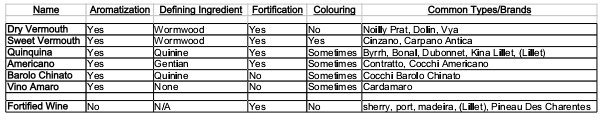
"Aromatized" wines are macerated with botanicals to impart both flavour and colour. Depending on the type of botanicals used, these wines are separated into basic categories: quinquinas, americanos, barolo chinatos, vino amari, and vermouths. Fortification is also an important part of this process, meaning that a spirit (usually brandy) is added to the wine at some point during the production process. This will increase alcohol content, and depending on the stage at which the wine is fortified, will also increase sugar content. Wines that are fortified but not aromatized include sherry, port, and madeira. Typically vermouths, americanos, and and quinquinas begin as a white wine or a mistelle, which is when a spirit is added to crushed grapes to produce alcohol rather than using strictly fermentation. These wines are then macerated with botanicals, and in the case of darker coloured aperitifs (such as sweet vermouth) usually coloured with caramel.

How each of these categories are differentiated is mainly by specific botanicals used for maceration. For example, vermouth used wormwood, quinquina used quinine from cinchona bark, and americano (named from “amer,” meaning bitter) used gentian and often wormwood as well.

Below is a chart of the basic types of aromatized wines, including their traditional specifications:


Because of the lack of clarification, some products end up in a sort of limbo between definitions. Lillet is an excellent example. Many bartenders call it a vermouth, but because it does not contain wormwood, it is not a vermouth by traditional definition. More importantly, Lillet is not aromatized, but rather a Bordeaux wine blend (85%) fortified with citrus liqueurs (15%), which themselves have been aromatized. This technically makes Lillet a fortified wine but not an aromatized one. Lillet was originally called Kina Lillet until the recipe was changed in 1987, and did actually contain quinine, so originally Lillet would be considered a quinquina. Today's recipe claims to still contain quinine, but this is neither confirmed nor evident. Cocchi Americano, which is supposedly a good approximation of Kina Lillet, contains gentian as a major component so is considered an americano (hence the name). 

Things are for the most part confusing, so while it is important to know the history and general distinctions between these types of wines, the most important factor is taste. Each of these products have their own place and use and should not always be used interchangeably. Most importantly of all, they are wines and need to be treated as such. They will go off over the course of a few days to a few weeks depending on the product, and should be kept in the fridge if stored.

Next post I will delve deeper into vermouth with more specific history and geography of the major brands.


 [[ originally published on www.shakestir.com by Rhett Williams ]]

Tuesday, 19 February 2013

Five Classic Cocktails for a Distinguished Gentleman

While times are changing for the better, most men drink cheap beer, highballs, or sugar-filled shots. Thanks to the growing classic cocktail trends in today's large city bars, the growing number of small distilleries and breweries, and television shows like Mad Men and Boardwalk Empire, more and more are becoming interested in better quality products and more traditional drinks. The mid to late 19th century was the Golden Age of mixed drinks, led by the 'grandfather of mixology,' Jerry Thomas, who in 1862 was the first to publish an all-encompassing tome of bartending. Many great drinks and products were lost during Prohibition, and while the practice of drinking well did continue to a lesser extent from the 1930's until the 1960's, it is for the most part the great classics from the Golden Age that survive today. A distinguished gentleman appreciates these drinks for their taste and history, and cares for the manner in which they are made. This sophisticated man knows there is only one Martini, that anything called a "cocktail" must contain bitters, and that an Old-Fashioned must never contain juice or soda. Below are five classic drinks for this distinguished gentleman.

(As per the previous posts on Classic Cocktails for a Fancy Lady, drink-preference should not be gender specific, and the purpose of this post is historical. Furthermore, should any lady deem herself too dangerous to be fancy, any of the following make excellent substitutes as cocktails for a femme fatale.)

Old-Fashioned
This is the drink with the most variations, the source of so many debates, the biggest growing popularity, yet one of the most misunderstood. Thanks to Donald Draper on TV's Mad Men (who, by the way, makes a terrible Old-Fashioned), this drink is now ordered by droves of non-experienced drinkers. This is an exciting trend. The disappointing news is that practices from the dark ages of drinking (the 1970's to the 1990's) are still alive today, and the drink is often ruined or just unrecognizable. It is a finicky drink to maintain the balance of so few ingredients, and of course most everyone prefers his or hers a slightly different way. The drink’s history is a confusing one because it refers to a style and not one particular drink. In the early to mid 19th century, The Sling was a popular mixed drink that contained only spirit, sugar, water, and perhaps a grate of nutmeg. At some point bitters was added to the mix, birthing the “Bittered Sling,” which came be known as the “Cock-tail.” Faster than you can mix one up, variations were born. Fruits here and liqueurs there muddled up the original, and purists and old-farts began to request their Cock-tails the “old-fashioned way.” Over time this simply became an “Old-Fashioned.” Anything beyond the Bittered Sling recipe is not an Old-Fashioned, though very small embellishments included in Jerry Thomas’ variations (namely orange or lemon oil) are welcomed. The recipe below is from “Modern American Drinks” by George Kappeler in 1895, and is the best way to make a proper Old-Fashioned. (Note the absence of juice, muddling, soda, or any liqueur.) The type of bitters and spirit is up to the drinker and trying new combinations makes for a multitude of exciting options (try brandy and Peychaud’s, tequila and chocolate, or gin and Boker’s for example).

2oz whiskey
2 dashes Angostura bitters
1/2tsp of sugar (or one small sugar cube)
1 piece of lemon peel

Dissolve the sugar with a little water in a whiskey-glass [Old-Fashioned or rocks glass]; add bitters, a small piece ice, a piece lemon-peel, and whiskey. Mix with a small barspoon and serve.

"A small piece ice" can be substituted today with a few nice cubes (don't ruin the drink with small, watery ones), and the lemon peel can be swapped for orange if you please. Express the oil of the peel over top of the drink for best effect. A common practice is to soak the sugar in both water and bitters before adding ice and spirit.

Sazerac
Ordering this drink more than five years ago would have gotten you strange looks. Because of its history and fantastic taste, it was and is an obscure favourite among cocktail enthusiasts. Many claims are made to it being the oldest cocktail, but this is not true. We’ve tracked its inception to 1850's New Orleans in a slightly different form than we most often enjoy now. The Sazerac is the product of two smart men: one who imported the Sazerac de Forge et Fils, and the other who changed the name of his bar to "Sazerac House," where the cocktail was first made and became popular, thus naming it the "Sazerac Cocktail." Peychaud's bitters was literally made down the street, so it was the obvious choice. The first printed recipe in 1908 called for “good whiskey” (which in New Orleans means straight rye) at which point Cognac had become less abundant. The drink's flavour is dry and spicy, and the union of Peychaud's, absinthe, and rye (or Cognac for that matter) is something truly special. Again, the process of making the drink is important for both flavour and anticipation, so follow it closely. Use a good quality spirit, preferably a higher-proof and spicy rye, absinthe if you can, raw sugar, and lastly you can substitute Bitter Truth Creole Bitters for Peychaud's (but go with one fewer dash as it's more potent).

2 oz straight rye whiskey [or Cognac]
1 sugar cube
2-3 dashes Peychaud's bitters
Absinthe
Lemon peel

Fill an Old-Fashioned or Sazerac glass with cracked ice. Put the sugar in a mixing container, add the bitters and a little water and let dissolve. Add the whiskey, fill with ice, and stir. Dump the ice out of the glass and pour in a little absinthe, and roll around to coat the glass before discarding. Strain the whiskey mixture into the glass, then express the oil from the lemon peel over top and drop it into the glass.

Manhattan
This one is the probably the most famous and enduring of all classics, enjoyed by many in literature and film, particularly gentlemen, but also by bad-news ladies like Marilyn Monroe in “Some Like It Hot.” Vermouth entered the mixed drink equation sometime in the 1870's, drastically changing things for generations to come. Suddenly cocktails weren't just spirits with small additions of liqueurs, bitters, sugars, and sometimes fruits. Now spirits shared the spotlight or even had a supporting role in many popular drinks. Arguably the first of these was the Manhattan, made at the Manhattan Club in, yes, Manhattan. Its first mention was in the 1870’s, its first recipe in 1884, and the closest recipe to what we use today appeared in 1892. Early incarnations included maraschino, absinthe, gum syrup, and no whiskey specification, but the drink simplified over time. The type of whiskey and bitters are still optional, and like the Old-Fashioned make for very different drinks. A higher-proof whiskey mixes better, with rye being drier and spicier and bourbon being fuller and sweeter. Always stir, never shake, serve up and not on the rocks, and the garnish is always optional.

2oz whiskey
1oz sweet vermouth
2-3 dashes bitters

Add ingredients to a mixing glass, add ice, stir, and strain into a cocktail glass. Garnish with a real cherry, or a citrus peel (optional).

Martini
The Manhattan-style cocktail at times contained gin instead of whiskey, which became known as the Martini - the same drink save the spirit choice. The origins of the Martini are some of the most disputed of them all, numerous ones appearing around the same time, but the concept remained the same. The Turf Club is the simplest, while The Fourth Degree contained absinthe, and The Martinez contained maraschino and twice the amount of vermouth. The later and most popular incarnation, The Dry Martini, made an important change in recipe: swapping Italian vermouth for French. As time wore on after Prohibition, Martinis got drier and drier, reducing the vermouth down to smaller and smaller amounts. In the later half of the 20th century good-quality vermouths were harder to come by and the lack of knowledgeable bartenders left it sitting on shelves instead of fresh and in the fridge, and the vermouth became essentially non-existent. Furthermore, James Bond confused many by calling his Kangaroo Cocktail a "Vodka Martini" (which even confused the Bond girl). A classic gentleman does not drink a Martini with vodka, though will sometimes drink it dry. However, a Martini without dry vermouth or bitters is not a Martini. Below is the classic 1890's version, in which you can reduce the amount of vermouth and swap the orange peel for a lemon if you please. The olive is a later addition, and can mask the flavours of the drink, but to each his own. Be sure to use fresh vermouth - it is wine and should be kept in the fridge and will spoil and then ruin your drink. Choose a good gin and a great vermouth.

2oz gin (Old Tom traditionally, but London Dry works just fine)
1oz dry vermouth
1 dash orange bitters

Stir ingredients with ice and strain into a cocktail coupe. Squeeze a piece of orange peel over top.

Negroni
In 1860’s Italy, Gaspare Campari invented the most famous of amari, aptly named Campari, before settling down and opening a cafe. The signature drink there was the “Milano Torino,” combining Campari from Milan and Cinzano vermouth from Turin then topped with soda. The early 20th century brought an influx of American tourists, among whom the drink found popularity and was renamed the “Americano.” (It found popularity elsewhere too, even being the first drink James Bond ever ordered). In 1919, Count Camillo Negroni asked the bartender, Fosco Scarselli, at the Caffe Casoni for a stronger version of this drink by swapping the soda with gin. This drink subsequently became wildly popular in Europe. In 1947, iconic director/actor Orson Welles was working on his film "Cagliostro" in Rome, and spoke to reporters about his new favourite drink, The Negroni, saying "the bitters are excellent for your liver, the gin is bad for you - they balance each other." It wasn't long before the drink became popular in the U.S., though in the more American style it was enjoyed up rather than on the rocks. The three ingredients balance and accent each other beautifully, and as such the Negroni structure has been used for numerous variations and new concepts. The most notable - drinks also worthy of a distinguished gentleman - are the Boulevardier, which replaces the gin with bourbon, and the Old Pal, which switches gin for straight rye and Italian vermouth for French. While Campari is very bitter and therefore an acquired taste, it's a worthwhile one, and the Negroni is a drink bound to be in your life for good.

1oz London Dry gin
1oz Italian vermouth
1oz Campari

Add ingredients together and stir with ice. Strain over rocks in an old-fashioned glass. Garnish with a slice of orange a piece of lemon peel.


[Photo: Cary Grant]

Friday, 11 January 2013

Five Classic Cocktails for a Fancy Lady

Taste should not be gender-specific. Good food and drink are enjoyed by any, and there shouldn't be "manly" drinks and "girly" drinks - but there are. There are a few reasons for this:
- Generally, women taste things differently than men - they tend to be more sensitive to flavour, particularly bitter. Because of this sensitivity, women often have more distinguished palates. (Again, this is a generalization, but scientific research does support it).
- In western culture, the woman was seen as the weaker sex and therefore shouldn't be enjoying the same things men do, such as strong drink. This is particularly true for cocktails in the first half of the twentieth century when many a book and magazine told women what they should be drinking in order to be a proper and all-around good lady. These drinks were colourful and sweeter.

In the dark ages of bartending (the 1970's-1990's) the above points were interpreted into drinks involving copious amounts of sugar, artificial colour, drinks with 'feminine' names, and a lot of vodka so as to further disguise the taste of alcohol. Many of the classics had both pretty colours and names but also happened to be great drinks, and strong ones at that. These cocktails were not gender-specific, or often started as a "gentleman's drink" (see the Clover Club) before becoming popular amongst the female folk, likely due to the media and populace deciding that a pink drink should be for a woman.

For this list, I'm taking inspiration from the 1920's to 1940's in particular, when men were gentlemen and women were ladies, and there were excellent drinks on both sides to be enjoyed by all. Should you wish to drink like a fancy lady of the time, below are some classic suggestions.

Clover Club
This light and pink drink predates Prohibition when it was enjoyed by the members of the Philadelphia men's club of the same name. By the 1930's, it had lost popularity, and 1949's "Handbook for Hosts" from Esquire placed it in the "something for the girls" section. If made properly this drink can be drier than expected, using fresh raspberries and not artificial liqueurs or commercial sweeteners. The Okanagan Spirits liqueur is an excellent substitution for real raspberry, tasting both dry and natural. If using a home-made raspberry syrup, bump up the gin and juice or lower the sugar amount. Below is the recipe from Pourhouse in Vancouver, which is fairly close to the recipe of old:

1.5oz London Dry gin
0.5oz fresh lemon juice
0.5oz simple syrup
0.5oz Okanagan Spirits Raspberry Liqueur
1 egg white

Combine ingredients and dry-shake. Then add ice and shake again. Strain into a cocktail coupe.  

French 75
A refreshing start to your evening, particularly a celebratory one due to the addition of sparkling wine. As with any drink, it should be made dry so as to awaken your palate and if so it makes an excellent aperitif. Created in 1915 by Harry MacElhone at the New York Bar in Paris, it was named after the WWI French 75mm field gun - which “packed quite a punch." German officers famously order it at Humphrey Bogart's bar in 1942's "Casablanca." Cocktail historian David Wondrich suggests increasing the gin to 2oz and serving over ice in a Collins glass. While this tastes better, I prefer the drink in more elegant attire. Here is the Savoy Cocktail Book recipe from 1930:

2/3 gin [1oz]
1/3 lemon juice [0.5oz]
1 teaspoon powdered sugar [0.5oz simple syrup]

Shake ingredients with ice and strain into a Champagne glass or cocktail coupe, then top with chilled Champagne or a dry sparkling wine (Brut).

Sidecar
This cocktail's origins are of some dispute, as so many are, but while the Ritz Hotel in Paris claims its birthplace, there are earlier and more reputable sources that differ. Harry MacElhone's 1922 cocktail book "Harry's ABC of Mixing Cocktails" gives credit to Pat MacGarry at Buck's Club in London some time after WWI. It was named after the motorcycle sidecar in which an American army captain was driven to the Paris bistro where the drink was created for him. It is essentially a Brandy Daisy, a style of drink dating to the mid 19th century. There are several recipes, namely the "French school" which has each ingredient at equal parts, and the "London school," which has 2:1:1 brandy to liqueur to lemon. David Embury's very influential "The Fine Art of Mixing Drinks" in 1948 recommends 8:2:1. I like my drinks dry, and below is my go-to recipe. Avoid the sugar rim, a practice that popped up in the 1930's and is both sticky and unnecessary. This drink is fruity but boozy and perfect for an elegant lady who has come in from the cold. It also happens to be Cointreau's signature drink, a liqueur represented by the fanciest lady alive today: Dita Von Teese.

2oz Cognac or other brandy
0.5oz Cointreau
0.5oz lemon juice

Shake ingredients with ice and strain into a cocktail coupe.

Champagne Cocktail
In the 19th century this drink was one of the very first variations on the “cock-tail,” a combination of spirit, sugar, water, and bitters. Embellishments were inevitable, and the best of them is likely the addition of brandy (technically making this a “Brandy Champagne Cocktail”). Adding this extra punch to the equation balances the sugar much better. This cocktail has shown up in both literature and film, most famously in 1957’s “An Affair To Remember” with Cary Grant and Deborah Kerr, and again in “Casablanca.” Don’t skimp on the bitters, and be sure to use a very dry sparkling wine lest the drink be cloyingly sweet.

1 raw sugar cube
Several dashes of aromatic bitters (Angostura)
1oz Cognac or other brandy (optional)
Champagne or dry sparkling wine

Drop the sugar into a Champagne coupe or glass and soak it in the bitters. Pour in the brandy, then top with the wine. Garnish with a lemon twist.

Arsenic and Old Lace
This one is a little more obscure, but perfectly fit for a classic lady in that it’s floral, light purple in colour, and dry. Descending from the pre-Prohibition Attention Cocktail, this one hails from the 1940’s and was considerably more dry. Modern recipes for both are basically the same, with the Attention having the addition of orange bitters, which makes for a more interesting drink with a less interesting name. The name comes from the black comedy play from 1939 which was later adapted by Frank Capra into a film starring Cary Grant. The story revolves around a drama critic who tries to protect his homicidal aunts who like to murder old men with poisoned elderberry wine. The recipe below changes the classic one by reducing 0.5oz of pastis to an absinthe rinse. Absinthe makes the flavour more complex, but is more potent than pastis and can overwhelm the drink so no more than a rinse is necessary. It employs crème de violette, an ingredient lost for decades until a few years ago. The quality of this violet flower liqueur will determine the overall quality of this drink, so be sure to avoid overly perfumey artificial ones and to balance accordingly.

1.5oz gin
0.5oz dry vermouth
0.25-0.5oz crème de violette
Absinthe rinse

Rinse a cocktail coupe with absinthe by pouring a little into the glass and spinning so it coats the inside before discarding the excess. Stir gin, vermouth, and violette with ice, and strain into the coupe. Garnish with a lemon twist and express the oils over the top of the drink.

Next post (which you can see here) I'll be sharing another five classic cocktails for a lady, then we'll get into those for the gentlemen.
[The science of taste and intoxication and how they relate to gender can be found in the science section of this site.]

Tuesday, 18 December 2012

Winter Cocktails: "Bear Skin" from The Refinery in Vancouver

Today's cocktail comes from Vancouver's downtown Granville Street. Hidden amongst the nightclubs is the delicious tapas menu from chef Kirk Morrison and the cuisine-inspired bar program of Graham Racich and Joel Virginillo. The cocktails here focus on local and house-made ingredients, including a wide array of bitters, vermouths, and even fermented sodas.
(You can see an old review of The Refinery here,
as well as "The Lucky Lady" from Fernet February,
"Primer Beso" from Maraschino March,
and "The Fellini" along with an interview with Joel).

This month, Graham has contributed a recipe for a winter cocktail employing one of the aforementioned house-made vermouths, an infused simple syrup, and some of The Refinery's coffee bitters. Should you be adventurous enough to experiment at home, the idea behind both making your own vermouth and bitters is steeping herbs in an alcoholic base. In the case of vermouth, start with a wine or fortified wine (Darcy O'Neil offers some good advice here on his site), and in the case of bitters start with a high-proof spirit and be sure not to skimp on the bittering agents (like gentian, wormwood, cinchona, etc). I won't get into the specifics yet, but I am planning a series on home-made bitters in the future.

Should you choose to take an easier route, coffee bitters are available from some brands commercially, such as Cocktail Kingdom and Masters of Malt. Steeping a store-bought dry vermouth in both chocolate (perhaps cocoa nibs) and roasted nutmeg is an approximation of The Refinery's vermouth, as those are the two main flavours Graham has mentioned to me. For the syrup, as with any, steeping orange peel and cinnamon sticks in your simple syrup solution as it's simmering will extract the flavours you want.

All that is fine and dandy, but perhaps the best and easiest way to try this drink is to head down to The Refinery and try one the way it's meant to be made.

Bear Skin
1.5oz 15-year aged rum
0.5oz homemade chocolate vermouth
0.5oz Punt e Mes
0.25oz orange-cinnamon simple syrup
Dash of coffee bitters

Stir ingredients with ice, strain into a coupe.  


More Holiday Drinks!
[["Yukon Cornelius" from Veneto in Victoria ]]
[[ "The Rockefeller" from Veneto in Victoria ]]
[[ The Hot Toddy ]]
[[ Winter drinks from Smuggler's Cove in San Francisco ]]
[[ "Bear Skin" from The Refinery in Vancouver ]]
[[ "Cold & Delicious" from The Violet Hour in Chicago ]]
[[ The history of Eggnog ]]
[[ "Gold," "Frankincense," and "Myrrh" from Trevor Kallies in Vancouver ]]
[[ "Old Saint Juan" from Shea Hogan in Vancouver ]]
[[ "Hot Buttered Rhum Cider" from Slanted Door in San Francisco ]]
[[ The history of mulled wine ]]
[[ The history of The Flip ]]
[[ Hot Buttered Rum ]]

Friday, 26 October 2012

Classic Halloween Cocktails

We are seeing many modern cocktails this month, so it seems like a good time to take a quick break and see some classics. While there aren't any drinks specifically created for Halloween celebrations (or rather, any that survived the years in print), there are some with names that fit just fine with the holiday.

The most obvious of these are the "Corpse Revivers." This 'family' of cocktails dates back to the mid-late 1800's, and were designed to "revive the corpse" the morning after a night of heavy drinking. These cocktails bear little resemblance to each other aside from the name. It wasn't until Harry Craddock published his "Savoy Cocktail Book" in 1930 that any of these recipes showed up in print. The most popular is the "Corpse Reviver #2" (in my opinion the best of them), which you can read more about here in an old post.

Corpse Reviver #2
3/4oz gin
3/4oz lemon juice
3/4oz Lillet 
3/4oz Cointreau
Dash of absinthe

Combine all ingredients with ice, shake, and strain into a coupe.

Use Cocchi Americano instead of Lillet for better and more historically-accurate effect, as Lillet changed its recipe in the 1980's to a much sweeter version without the bitter flavour of quinine. It really makes a difference.
As for the absinthe, feel free to use pastis, Pernod, Herbsaint, or other suitable substitutions. The difference is not as noticeable as Cocchi/Lillet, but absinthe is also better and more accurate, so use it if you have it.

The other Corpse Revivers are much harder to come by. Searching in books or websites for #3 will bring you completely different ingredients, but I trust Robert Hess, who lists a recipe of equal parts brandy, Campari, and triple sec, with a 1/2 part of lemon juice. #1 is a more interesting drink, and one worth trying if you can get your hands on some applejack (which we can't in Canada):

Corpse Reviver #1
2oz brandy
1oz sweet vermouth
1oz applejack

Combine ingredients with ice, stir, and strain into a coupe.

"The Savoy Cocktail Book," one of the better historical drink books you will find, brings us another cocktail suitable for Halloween and different than the usual in that it contains orange juice: "Satan's Whiskers." There are two versions listed, the "Straight" using Grand Marnier, or the "Curled" using a different orange curacao (Cointreau or triple sec works just fine in this drink as well). It is similar to a Bronx cocktail, which is just gin, sweet and dry vermouth, and orange juice without the liqueur or bitters.

Satan's Whiskers
3/4oz gin
3/4oz sweet vermouth
3/4oz dry vermouth
1/2oz Grand Marnier (or other orange curacao)
1/2oz orange juice
Dash of orange bitters

Combine ingredients with ice, shake, and strain into a coupe.

Last up is the Zombie, a drink that has sparked many a debate over the years. The original was created in 1934 by Don the Beachcomber. Tiki drinks tend to contain a lot of ingredients, which fans the flames in the recipe debate. The modern go-to man for Tiki is Jeff "Beachbum" Berry, so I will list his recipe, and I will also list Martin Cate's from the best Tiki or rum bar I've ever been to - Smuggler's Cove in San Francisco. Martin's recipe is essentially the original. (For more ideas, Gary Regan, Dale Degroff, and Dr. Cocktail have all come up with recipes too).

Zombie (Jeff "Beachbum" Berry)
1oz lime juice
3/4oz pineapple juice
3/4oz papaya nectar
1/2oz applejack
1oz dark Jamaican rum (Myer's)
2oz Barbados rum (Mount Gay)
1oz light Puerto Rican rum (Brugal)
1/2oz 151 Demerara rum (Lemon Hart)

Shake everything with ice except the 151. Pour into a tall glass, fill with ice, and float the 151 on top. Garnish with a cocktail cherry, pineapple slice, and a sprig of mint if you desire. Sprinkle powdered sugar on top.

Zombie (Martin Cate)
6oz crushed ice
3/4oz lime juice
1/2oz grapefruit juice
1/4oz cinnamon syrup
1/2oz falernum
1.5oz Puerto Rican gold rum
1.5oz aged Jamaican rum
1oz Lemon Hart 151 Demerara rum
1 teaspoon grenadine
Dash Angostura bitters
6 drops of Pernod or Herbsaint

In a blender jar, add all ingredients and blend until slushy, about 2-3 seconds. Pour contents into a zombie or pint glass and add more crushed ice to fill. Garnish with a sprig of mint.


The Fall Series:
You can see the series introduction here
and more terrible Halloween cocktails here
"Death & Oranges" by Donnie Wheeler
"Jones' Bitter Aperitif" by Evelyn Chick 
"The Satchmo" by Simon Ogden 
"Dark City" by Jay Jones
"The Giant Huntsman" by Lauren Mote
"The Bay Harbour Butcher" by Shaun Layton  
"A Nightmare On Juniper Street" by Shea Hogan 


[[ Photography by
smallscreennetwork.com - Corpse Reviver #1
understandingcocktails.com - Satan's Whiskers
tastingtable.com - Martin Cate's Zombie ]]

Monday, 13 August 2012

Bittered Sling Extracts: David Wolowidnyk at West

Our final Bittered Sling contribution takes us to South Granville where we visit both a restaurant of great renown and a bar program run by one of Canada's most recognized bartenders, and thanks to the cocktail being shared today, he's now recognized world-wide. West, or Ouest as it was originally known, has been consistently viewed as one of Vancouver's best food options since it opened in 2000, with its delicious West Coast style cuisine, and delicate and regional-inspired desserts. With an award-winning staff from the kitchen to the bar and sommellier to management and service, West has it covered from every angle. The bar sports a huge array of spirits, and a full wall of temperature-controlled wine selections, including thirty offered by the glass. It is definitely one of my favourite places to both eat and drink in the city.
Bar manager David Wolowidnyk has resided at West for eight years now, racking up awards from magazines like Urban Diner and GQ, festivals like Art of the Cocktail, and world-wide spirit competitions from national brands. Most recently, David represented Canada in Morocco for the "World's Most Imaginative Bartender" competition presented by Bombay Sapphire, where his original cocktail, "Beldi," won him the competition. Thousands of competitors contributed from all over the world, but it was David's combination of flavours inspired by his experience in Marrakech that proved to be the best.
Combining botanical flavours from the Bombay gin with others from the region, "Beldi" brings strong and complex spice elements to a very basic cocktail structure (essentially a Martini), creating a light and refreshing drink that piques curiosity with each sip. An ingredient list will give an idea of this drink's depth: saffron, ginseng, mint and mint tea, cinnamon, cassia, coriander, almond, lemon, liquorice, juniper, orris root, angelica, cubeb, grains of paradise, plus the wealth of herbs and spices in the Bittered Sling Lem-Marrakech bitters.

Beldi

45ml Bombay Sapphire Gin infused with Moroccan Saffron and Ginseng
20ml Martini Bianco infused with Moroccan Mint Tea and mint leaves
15ml Cinnamon & Cassia Syrup
2 dashes Bittered Sling Lem-Marrakech Extract
Toasted Moroccan coriander tincture


Combine gin, vermouth, syrup, and extract with ice and stir in a mixing glass.
Mist a chilled cocktail glass with the toasted coriander tincture.
Strain the mixture into the glass and garnish with a lemon zest.
Mist the tincture again over the surface of the drink.


(Instructions for making the infusions, syrup, and tincture are at the bottom of this page)

West's cocktail menu is equally filled with well-chosen classics and some fantastic originals. The mix of both classic bartending and modern "mixology" hits a perfect balance here. A dealer's choice is always an exciting choice as well, so make your way down soon and supplement your "Beldi" with another of David's creations. Stay for dinner too.

See the Bittered Sling introduction here
See Dani Tatarin from The Keefer mix something up in her Chinese apothecary-style here
See Justin Taylor from Yew mix up some infused and barrel-aged spirits here
See Evelyn Chick from Uva Wine Bar make some fresh-fruit seasonal cocktails here 
See Jay Jones from Market by JG in the Shangri-La Hotel mix a spirit-forward classic-stye drink here
See Grant Sceney use his barrel-aged Cointreau here


Infused Gin
1.75L bottle of Bombay Sapphire
8 x pieces of dried ginseng
1/8 tsp saffron
Combine & let sit for 24 hours then strain off solids

Infused Vermouth
Cold-steep 1tsp of Moroccan Mint Tea with
6-8 mint leaves
in one bottle of Martini Bianco vermouth
strain off solids and keep refrigerated.

Cinnamon / Cassia Syrup
1 stick of Cinnamon
1 stick of Cassia
1.5L water
Boil Cinnamon & Cassia in 1.5L of water until reduced to 1 litre
Strain solids
Measure 2 parts sugar to 1 part liquid
Simmer until disolved 
Cool before bottling in a sealed container and refrigerate

Toasted Coriander Tincture
500ml Coriander Seed, toasted in a dry pan on medium heat
Crush/Grind toasted seed
500ml Bombay Sapphire Gin
Infuse for 24 hours
Strain out solids through a fine filter
Note: Normally David would use a higher proof alcohol to make a tincture, yet during the competition he had to work only with products on hand or that he was able to acquire in Morocco.