Showing posts with label lillet. Show all posts

Wednesday, 3 July 2013

Aromatized Wine Classification

By North American standards, vermouth was once a stale, stinky wine collecting dust on the backbar waiting for some weirdo (probably European) to order a wet Martini. This wasn't actually that long ago. Many drinkers (myself included) claimed they hated vermouth without realizing they were most likely ruining drinks with oxidized bottles. Once the interest in classic drinks returned and brought with it the knowledge of product care and desire for those of higher quality, vermouth's reputation began to change. New vermouths were hitting the market and old ones became more available. Furthermore, similar products came into common use, such as Cocchi Americano, Lillet, and Byrrh, to name a few. Despite their much stronger presence today, they still seem to be enigmatic to some. Most drinkers can classify whiskeys, but can they classify vermouth, americano, and quinquina? Even experienced bartenders aren't making the distinction between different types of aromatized wines, so perhaps it's as good a time as any for a little history and classification.

Where did they come from?

The practice of aromatizing wine dates back to at least 400 BC in Greece, the purpose of which was both to mask poor-quality or spoiled wine and to create medicinal tonics, just as most spirits and liqueurs originate. Once distillation became commonplace after the 12th century, wines began to be fortified as well as aromatized - most notably in 16th century Germany, with usually a brandy being used to fortify and wormwood for aromatizing. This herb was believed to cure stomach and intestinal disorders and parasites, and the drink began to include many other herbs and spices and became a cure-all, much like bitters. These "wormwood wines," or "wermut" in German, became popular in England over the next hundred years, and the name became anglicized to "vermouth." Italy and later France took the reins on vermouth production, but by the late 1800's it was not the popular drink it once was - particularly in a medicinal sense thanks to the popularity of bitters. It was around this time that vermouth found its way into early cocktails via two of the most famous mixed drinks known to man: the Manhattan and the Martini.

What about these other kinds of aromatized wines? Wormwood was not the only medicinal herb being infused into wine. Quinine (via South American cinchona bark) and gentian root were also common, along with different combinations of popular ingredients, like cinnamon, cardamom, cloves, coriander, chamomile, and vanilla. So is a vermouth, or "wormwood wine," still a vermouth if it doesn't contain wormwood? Technically, no. Here's where it gets tricky: when absinthe was banned in the early 20th century thanks to the reputation of wormwood, many vermouth producers stopped using the herb as well. This irreparably confused aromatized wine classification for years to come as many of the vermouths we knew and loved didn't contain their title ingredient anymore. Now that the age of anti-absinthe propaganda has passed, wormwood has become common in bartending, but there are still numerous vermouths that use little or none of the herb in maceration. It doesn't help that there are no legal requirements for aromatized wine production, so anything can be added or omitted. This leaves us with history to aid in classification by looking at what the products originally contained in the cases where the recipes have been changed.

How are they made?

"Aromatized" wines are macerated with botanicals to impart both flavour and colour. Depending on the type of botanicals used, these wines are separated into basic categories: quinquinas, americanos, barolo chinatos, vino amari, and vermouths. Fortification is also an important part of this process, meaning that a spirit (usually brandy) is added to the wine at some point during the production process. This will increase alcohol content, and depending on the stage at which the wine is fortified, will also increase sugar content. Wines that are fortified but not aromatized include sherry, port, and madeira. Typically vermouths, americanos, and and quinquinas begin as a white wine or a mistelle, which is when a spirit is added to crushed grapes to produce alcohol rather than using strictly fermentation. These wines are then macerated with botanicals, and in the case of darker coloured aperitifs (such as sweet vermouth) usually coloured with caramel.

How each of these categories are differentiated is mainly by specific botanicals used for maceration. For example, vermouth used wormwood, quinquina used quinine from cinchona bark, and americano (named from “amer,” meaning bitter) used gentian and often wormwood as well.

Below is a chart of the basic types of aromatized wines, including their traditional specifications:
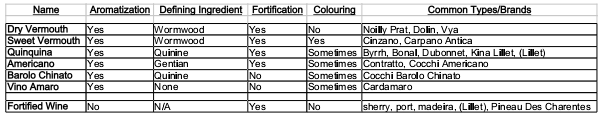


Because of the lack of clarification, some products end up in a sort of limbo between definitions. Lillet is an excellent example. Many bartenders call it a vermouth, but because it does not contain wormwood, it is not a vermouth by traditional definition. More importantly, Lillet is not aromatized, but rather a Bordeaux wine blend (85%) fortified with citrus liqueurs (15%), which themselves have been aromatized. This technically makes Lillet a fortified wine but not an aromatized one. Lillet was originally called Kina Lillet until the recipe was changed in 1987, and did actually contain quinine, so originally Lillet would be considered a quinquina. Today's recipe claims to still contain quinine, but this is neither confirmed nor evident. Cocchi Americano, which is supposedly a good approximation of Kina Lillet, contains gentian as a major component so is considered an americano (hence the name). 

Things are for the most part confusing, so while it is important to know the history and general distinctions between these types of wines, the most important factor is taste. Each of these products have their own place and use and should not always be used interchangeably. Most importantly of all, they are wines and need to be treated as such. They will go off over the course of a few days to a few weeks depending on the product, and should be kept in the fridge if stored.

Next post I will delve deeper into vermouth with more specific history and geography of the major brands.


 [[ originally published on www.shakestir.com by Rhett Williams ]]

Tuesday, 22 January 2013

Five More Classic Cocktails for a Fancy Lady


Last post (found here) we went through some of the best classic cocktails for a lady, but the list to me feels incomplete without the following runner-ups.
 
Stinger
This drink is very simple and not particularly interesting in flavour - in fact, it can be way too sweet if made according to classic recipes. However, it is an excellent digestif to end your dinner or evening, and opens the door to some very interesting experimentation. Having a half-si
zed cocktail of Cognac or brandy with bitters, or amaro, and some representation of the mint flavour (be it Giffard menthe de pastille or Branca Menta or an amaro like Nardini) has become a mainstay of my drinking evenings. The drink also has a long American history, dating in literature back to 1917’s “Ideal Bartender” book, which lists it simply as equal parts of brandy and white crème de menthe. It was popular amongst pilots in WWI because the young men preferred drinks not to taste of alcohol, but also because the mint oil disguised the liquor on their breath (as cocktail historian David Wondrich reasons). The Stinger was a favourite of Billie Holiday, as well as enjoyed by the lovely Grace Kelly [right] in 1956’s “High Society,” Katherine Hepburn in 1940’s “Philadelphia Story,” and Jayne Mansfield and Cary Grant in 1957’s “Kiss Them For Me” (in which Grant says “stingers - and keep them coming.”) Giffard’s menthe de pastille can be substituted for crème de menthe (to better effect in my opinion), but is more potent and should be balanced accordingly. The below recipe is Wondrich’s:

2.25oz brandy

0.75oz white crème de methe

Shake well with cracked ice, then strain into a cocktail coupe.

Pink Lady
The name is a little obvious for a lady cocktail choice, the drink is pretty-looking, tastes fruity, but it still packs a punch. It also carries a foggy history. Originally the recipes only included gin, grenadine, and egg white (Cafe Royal Cocktail Book, 1937), but later incarnations included lemon juice, applejack or apple brandy, and even cream. Esquire’s 1949 “Handbook for Hosts” (mentioned last post) also has this one in the ‘for the girls’ section. In popular culture, 1950’s sex symbol Jayne Mansfield [right] used to drink them before meals, and in the 1937 film “Topper,” Constance Bennett gives one to Cary Grant.
The most accepted recipe comes from David Embury’s “Fine Art of Mixing Drinks” in 1948:

1.5oz gin
0.5oz apple brandy (or applejack)
0.5oz lemon juice

0.25oz grenadine
egg white

Shake ingredients without ice, then add ice and shake again. Strain into a cocktail coupe.

Twentieth Century
This is an excellent introduction to gin, or an excellent trick for anyone who claims they don’t like gin. It originated in 1937’s Cafe Royal Cocktail Book, credited to C.A. Tuck, a British bartender who created the drink in honour of the Twentieth Century Limited. At the time this was a wonder of modern technology: the world’s fastest and most luxurious train that ran from Chicago to New York at 60 miles per hour from 1902 to 1967. So fancy was this train and its many dining and drinking cars, that passengers boarded and exited the train upon a red velvet carpet, which is actually the origin of the phrase “red carpet treatment.” The train was featured in several films, most prominently in Alfred Hitchcock’s very influential “North by Northwest” (1959). The drink itself is like a chocolate meringue dessert, but can still be made dry enough to enjoy. Below is the traditional recipe, but click here to see a variation using egg white and substituting a Giffard white chocolate syrup for the very flat crème de cacao, along with a more detailed history.

1.5oz Plymouth gin
0.75oz Lillet Blanc

0.75oz white crème de cacao   
0.75oz lemon juice

Shake with ice and strain into a cocktail coupe.
 

Jack Rose
This pink and fruity sour has several theories of inception: named after a lying gambler who had a famous run-in with the law in 1912 (and who may have invented the drink himself), named after the Jaquemot rose because of the colour (as claimed in the book “Old Waldorf Bar Days” in 1931), or as recently uncovered in print in 1905, simply invented by a bartender at Gene Sullivan’s Cafe in Jersey City. Sadly the oldest printed account is the most likely one, negating the much more interesting Jack Rose the gambler story, which also lends the parallel of the drink itself being a liar, with its pink colour and fruity flavour masking what is actually a very strong drink. It is nonetheless a clever name, having both applejack and a rose colour. To be traditional, applejack should be used, but calvados is also acceptable and will offer a softer and fruitier drink. The juice is not specified between lemon or lime in the history books, but I find lime much more interesting. There are recipes galore on how to make this, and a major factor is how you make your grenadine. The simplest way is just to make a 1:1 simple syrup with real pomegranate juice in place of water, and this will enable you to balance drinks the usual way. Below is David Wondrich’s recipe:

2oz applejack (or Calvados)

1oz lime juice
0.5oz grenadine

Shake all ingredients with ice and strain into a cocktail coupe.

Aviation
A favourite among cocktail enthusiasts, the Aviation dates back to the 1910’s but underwent a recipe change in by 1930 when the Savoy Cocktail Book omitted one of its ingredients: cr
ème de violette. Throughout the next seventy-five years violette was for the most lost and forgotten as manufacture ceased, but thankfully in 2007 Rothman & Winter reproduced it and now we have several kinds available to us in North America. An Aviation without violette has none of the blueish colour for which it was likely named, and a much flatter-tasting drink altogether. Maraschino is somewhat of a challenge to the uninitiated, but with the balance of citrus and floral flavours makes this an excellent introduction. Below is Robert Hess’ adapted recipe. Click here to see a more in-depth history of the Aviation.

2oz gin

0.5oz lemon juice
0.5oz maraschino liqueur
0.24oz crème de violette

Shake all ingredients with ice and strain into a cocktail coupe. 

Friday, 14 December 2012

Winter Cocktails: "Gold," "Frankincense," and "Myrrh" by Trevor Kallies in Vancouver

There are a lot of newcomers to the site this month, and today I have the pleasure of sharing three drinks from a Vancouver veteran. Trevor Kallies is currently the bar and beverage director for the Donnelly Group, owners of sixteen bars, nightclubs, pubs, and barber shops in the city. He is an award-winning bartender and also a director and founding member of the Canadian Professional Bartenders Association. 

Trevor is graciously sharing recipes for three holiday drinks he's been working on, all festively named and all using a Kale & Nori Bittered Sling Extract, a line of bitters created by local chef and mixologist team Jonathan Chovancek and Lauren Mote.

Gold
1oz Jameson Irish Whiskey
1oz Benedictine
1 barspoon peach-jalapeño preserves
3 dashes Bittered Sling Plum & Rootbeer bitters

Shake ingredients with ice and strain into a cocktail glass rimmed with gold flakes. 

Frankincense
1.5oz Beefeater 24
1oz white grapefruit juice
0.5oz Yellow Chartreuse
3 dashes Bittered Sling Orange & Juniper bitters

Shake ingredients with ice and strain into a cocktail glass. Garnish with a spruce tip.


Myrrh
1oz Glenlivet Scotch Whisky
1oz Tio Pepe dry sherry
0.5oz Lillet
3 dashes Bittered Sling Moondog bitters

Stir ingredients with ice and strain into a cocktail glass. Garnish with mandarin orange zest layered with cranberries on a pick.  

Saturday, 27 October 2012

Halloween Cocktails: "The Giant Huntsman" by Lauren Mote


Not everyone finds spiders scary, but I certainly do and therefore find a drink named after the largest spider in the world to be fitting for Halloween. Lauren Mote from Kale & Nori (read more what they do here in the series on their Bittered Sling Extracts) brings us a cocktail in her complex culinary style using Oolong tea, yuzu juice, and her "Denman Bitters," featuring Asian spices. The arachnid after which the drink is named has over a 12 inch legspan making it the largest spider by size in the world (the largest by mass is the Goliath Birdeater).  

"Inspired by the largest spider of them all, with the same name. It's a big cave-dweller, with super long legs, and just discovered in the last 12 years in Laos. This cocktail includes some gorgeous ingredients inspired by the region, but you'll never think about spiders the same way again. It's refreshingly complex, balanced, and will leave you terrified of other cocktails.

The Giant Huntsman

1 oz Beefeater 24 Gin
1 oz Lillet
1 dash "Bittered Sling" Denman Bitters

0.75 oz “O5 Tea” Osmanthus Oolong Syrup
0.5 oz Yuzu Juice


Shake all ingredients together with ice, and service in a chilled cocktail glass. 
Garnish with a lemon cheek (spray the oils over the cocktail surface, and slide along the rim).

Oolong Syrup Method:
7 tsp of Oolong, steeped for 10 minutes in 1L of water. Strain, and mix the water with equal parts of white sugar until dissolved. Place into refrigerator for up to 10 days, and use as required.


Lauren recommends using O5 tea for the Oolong, which you can find at www.o5tea.com.
As for the Denman Bitters, click here to see current retailers, and be sure to check out the Bittered Sling Series for more cocktail ideas.


The Fall Series:
You can see the series introduction here
and more terrible Halloween cocktails here
"Death & Oranges" by Donnie Wheeler
"Jones' Bitter Aperitif" by Evelyn Chick 
"The Satchmo" by Simon Ogden 
"Dark City" by Jay Jones 
Classic Halloween Cocktails 
"The Bay Harbour Butcher" by Shaun Layton 
"A Nightmare On Juniper Street" by Shea Hogan 

Sunday, 29 July 2012

The Twentieth Century Cocktail


Classic cocktails have really been getting explored and revived over the last few years. Manhattans and Martinis and Sazeracs never really left, but Fourth Regiments and proper Aviations have slowly become commonplace in good bars all over the world. With innovators like David Wondrich, Dr. Cocktail, Gary Regan, Robert Hess, and their ilk writing books and collecting really old recipes, and even more current releases like the PDT Cocktail Book collecting tons as well, it's easy to suddenly feel a little saturated with drink ideas - lot of which are fairly similar, particularly if you want to rifle through pages upon pages of gin and vermouth variations in just about any 1930's cocktail book. Let's be clear here: this is not to put down in any way what these men and women have done, that is essentially the birth of an entirely new cocktail culture that for the previous thirty-plus years was arguably dead. It is also a little mind-boggling to think that they have themselves narrowed down the sea of cocktail ideas to what they deemed best, and yet I still feel a little daunted when trying to decide what to make next at home.
The key is really to narrow down the handful of truly important drinks that stand the test of time, or find those that stand out in their ingredients or purpose. A Last Word in a collection of pre-Prohibition cocktails, for example. So this brings me to my momentary obsession in a cocktail sense: The Twentieth Century. When thinking of chocolate in drinks, chocolate syrup and flavoured vodka at chain restaurants comes to mind, and not anything "classic," yet here is one hailing from the 1930's that can be balanced and refreshing, and thankfully has a gin base. Creme de Cacao is not a typical ingredient the cocktail nerds see nor many craft bartenders use, perhaps because of its modern associations or perhaps because it tends to be a fairly flat-tasting product. Yet, again, here is a simple, classic drink in which it works.

The Drink
The challenge of making a very old cocktail is finding the "proper" ratios with which to mix the ingredients, so the answer is always to just make it how you like it but to be mindful of how it was intended. Using too much chocolate liqueur would bring us back to that overly-sweet grossness that in part gave mixed drinks such a bad name, so be mindful that this is a gin drink and should be mixed as such. The PDT book lists 2:1 for gin to everything else, whereas Ted Haigh adapted his to 1.5 gin to 3/4 Lillet and lemon, to 1/2 creme de cacao, and I've seen ratios of lemon drop even to 1/4. I prefer my drinks drier in general so I lean towards the Haigh's recipe, but we also get into tricky territory without specifying the exact chocolate liqueur. Here's where my suggestion comes in - don't use creme de cacao. Vancouver's Pourhouse bar, one focusing almost strictly on classic cocktails or at least the mentality of such, makes their 20th Century quite differently to delicious results by using Giffard White Chocolate syrup and changing the proportions a fair bit. This makes for a surprisingly balanced drink that is not too sweet at all, albeit much less dry than some palates may be accustomed. This is an excellent drink to introduce or coax misinformed or close-minded souls to gin, and one that anyone - even those who sat at your bar looking for Appletini's - can enjoy. To play with the idea even further and treat this as a dessert cocktail, which in my opinion it is, an egg white can be added, with the suggestion to back off the syrup a little further as egg will increase the perceived sweetness.
A final note is the Lillet - the original would have used the original Kina Lillet, so substituting Cocchi Americano here would be more true to form.

20th Century (C.A. Tuck, 1937)

  • 2 parts gin
  • 1 part Lillet
  • 1 part lemon juice
  • 1 part creme de cacao
Combine all ingredients with ice, shake, and strain into a cocktail glass.

20th Century (Pourhouse)

  • 1 oz Tanqueray gin
  • 1 oz lemon juice
  • 1 oz Lillet Blanc
  • 3/4 oz Giffard White Chocolate Syrup
  • Egg white (optional)
Combine all ingredients and dry shake if using egg, then add ice and shake again and double-strain into a cocktail glass. If not using egg, garnish with a lemon cheek.

The History
The drink is credited to C.A. Tuck in the first publication of the "Cafe Royal Cocktail Book," written in 1937 by William J. Tarling, who was at the time the president of the United Kingdom Bartender's Guild and main barman at the Cafe Royal. This restaurant and bar, which had one of the finest wine cellars in the world, ran from 1865 until 2008, hosting many a good time for the likes of Oscar Wilde, Aleister Crowley, Virginia Wolf, Winston Churchill, up to Brigitte Bardot. Details on Tuck's station and career are elusive to say the least. The cocktail was named in honour of the Twentieth Centry Limited train that ran between New York and Chicago from 1902 until 1967. It was often called the "most famous train in the world," making the trip in twenty hours (which in the 30's was cut to sixteen) - four hours faster than any previous attempt. The train was also famous for its Art-Deco design and on-board luxuries, even including a barbershop, and boarding and exiting was a sophisticated affair with crimson carpets adorning the loading area, creating the phrase "red carpet treatment."
The 1930's in London marked a continued shift towards electricity and the use of motor vehicles from the old gas and carriage. While many industries felt depression all over Europe, London actually managed to avoid much of the damage, even seeing small booms in new industries like electrical equipment and food production. By the mid 30's, there was an influx of fearful Jewish immigrants to the city, and by the end of the decade many of them were of course escaping to the countryside. The beginning of a new decade was marked by the Blitz, the German bombing of the U.K. - most notably London - from 1940-1941, killing about 40,000 people.
Among the many lives lost was influential and iconic singer, Al Bowlly, who sang in Fred Elizalde's Savoy Hotel Band in the 1920's at the famous Savoy Hotel where Harry Craddock was mixing drinks and writing his seminal cocktail tome.  The jazz age brought artists to Europe, spreading a sound of music never heard before, and there were some British artists of note who became superstars during the swing era even across the Atlantic, namely Bowlly along with bandleaders Elizalde and Ray Noble. Bowlly made over 1000 recordings in his career, and was the first singer to headline live and radio performances instead of the bandleader, essentially being modern music's first "pop-star." He was also one of the first singers to perform with a microphone, allowing a softer and more versatile singing style that coined the term "crooner." While the 30's marked his solo career, including some trips to New York, he could still be seen performing at big venues in London. It’s possible you would sip a Twentieth Century cocktail, perhaps even made by C.A. Tuck, wherever he was, while listening to one of the great singers in modern music. Here is a very rare filmed performance in 1934 of a classic, "The Very Thought Of You," composed by Ray Noble and performed by heart-throb crooner, Al Bowlly.

http://www.youtube.com/watch?v=cr4ncMR5EVQ

Originally published on www.shakestir.com by Rhett Williams

Photography:
Twentieth Century Limited train circa 1930's (public domain)
Twentieth Century Cocktail 2012 from Pourhouse Restaurant, Vancouver (Rhett Williams)
Cafe Royal 1901 (public domain)

Thursday, 7 June 2012

Quinquinas and Americanos


Next is a classification of aromatized wine that isn't really referred to anymore, despite there being several very popular products that fall under its umbrella. Like vermouth, these classifications have blurred, in part due to the limited availability of some of the ingredients used in production, but also likely because people's tastes have changed so much and spirit and wine companies have shifted with that trend.

As mentioned in my post on vermouth, its original ingredients included wormwood, and a separate group of aromatized wines included primarily quinine and were appropriately named "quinquina" (keen-KEEN-ah). Quinine has a decorated history in early medicine dating back to the mid 17th century when Italians used it to cure malaria. Its source is Peruvian bark, Chinchona bark, or "Jesuit's Bark," which was used by indiginous South American people as a medicine. Italians there at the time noticed this and brought it back home where it became common use throughout most of Europe, especially amongst sailors who drank it simply with water. Adding a ration of gin made it more interesting, and a little lime made it more palatable (and also warded off scurvy), and thus is the birth of what we now call the Gin & Tonic. Medicinal tonics, as always, lead to popular social and recreational libations, and the French in particular enjoyed steeping their wines in it along with other herbs. All but one of the well-known quinquinas are French, with Cocchi Americano being Italian (of course it's essentially Kina Lillet, which is French).

"Americano" is actually another classification of these wines ("amer" as in bitter, not America) with a stronger focus on gentian root, and often contained wormwood as well. Americanos and quinquinas are usually grouped together, and I actually can't seem to find any particular product that is clearly defined as just americano. I assume Cocchi Americano is one, but only because of the name, because the flavour does include quinine and it can therefore be considered a quinquina as well.

Chinchona bark, as it is most often called today, is impossible to find in Canada as far as I've found. In a somewhat recent attempt to make my own bitters, I went from herb shop to herb supplier and so forth and none of them carried, none of them knew anyone who carried it, and a handful of them had no idea what I was talking about. So I ended up buying a bag of it for $2.00 at Pike Place Market in Seattle. That's a pretty typical end to most Vancouver stories.

Here are the only brands of quinquina (and americano?) that are available in the U.S. market:

Bonal Gentiane Quina - From St. Laurent du Pont in 1865, featuring quinine and gentian root.

Byrrh - from Thuir in 1866, one of the few fortified and aromatized wines to begin with a red wine base.

Cocchi Americano - originally created in Asti, Italy, in 1891. This is the closest taste you will find to original Lillet (Kina Lillet) since the recipe was changed in 1986.

Dubonnet - from Paris in 1846. The "rouge" is the classic recipe (or so we think), and the "blanc" is a newer American-market invention. After the the 1940's, the Dubonnet available in the American market has actually been made under license in Kentucky, which of course has led to debates on the validity of the product.

Lillet - from the Bordeaux region in 1887. As I mentioned in earlier posts, Lillet isn't really a quinquina anymore since it barely contains quinine - if any - so essentially serves as its own product and classification under the broad umbrella of fortified wines. It is essentially a dessert wine, being a blend of Bordeaux wines fortified with a little orange liqueur, so the proof and sugar contents are higher, but otherwise tastes much more like a wine than a vermouth or anything else. In 1986 the producers removed all or almost all of the quinine as well as the "Kina" in the title. The rouge version has been around since the 1960's, but only recently became more readily available, and a rose should be hitting the market soon. Any classic cocktail calling for "Lillet" should be made with Cocchi Americano as this is the most accurate representation of the flavours intended.

In Canada, you can easily get Dubonnet and Lillet at any decent liquor store, and you can find it for less than the states (yay us!). However, Bonal, Byrrh, and Cocchi are not available at all, and will require a trip down south (and the Cocchi is worth it).

Darker quinquinas (such as Dubonnet or Bonal) can serve in place of sweet vermouth in a cocktail, but balancing issues will arise so make sure you taste what you're doing! Similarly, Lillet and Cocchi can replace dry vermouth, but Lillet in particular is so light and sweet in comparison that you will not get the same results. With great products like Dolin unavailable to us up here, we are stuck with heavier-tasting vermouths that are more present in a cocktail than you would sometimes like, and an interesting idea might be adding equal parts of Lillet and vermouth instead. I just came up with that right now and have to go try it...

Check out the previous post on fortified wine classification
and this post on vermouth

Wednesday, 30 May 2012

Vermouth & Fortified Wine Classification

Between travel and my new jobs and projects (including writing for other websites) I've lost a considerable amount of time that I would otherwise have spent writing here on my own site. However, I plan to do a little recap of why I loved my recent Seattle visit so much (including a list of the best bars in town), and I'm also going to do a very short vermouth series. This could otherwise be one post, but I just don't have the time to do it all in one sitting, so I'm going to cut it up.

The inspiration for this is both my very recent purchase of Dolin French vermouth and Cocchi Americano (neither of which are available at all in Canada), and also a few separate discussions and debates I've had with bartenders about the definition of "vermouth." I actually work with a couple bartenders who call Lillet a vermouth, which it is not, so I figure a good and quick way to start is by clarifying some products categories.

To start it all off, vermouth belongs to a large family of drinks called "aperitifs" - alcoholic beverages consumed before a meal to whet the appetite. More specifically, vermouth belongs to the family of drinks called "aperitif wines," and for more clarification, "aromatized wines." These are wines that have been macerated/steeped/infused with botanicals of some sort to impart both flavour and colour. This includes vermouths, quinqiunas, americanos, barolo chinatos, and vino amari.

Fortification is also an important aspect of vermouth and many aperitifs and wines, and splits the family of aperitif wines and aromatized wines into further separate categories. To "fortify" a wine, a spirit - usually brandy - is added to the wine at some point during the production process. This not only increases the alcohol content, but in many cases will also cease the fermentation early, leading to higher sugar content in the product. Fortified but not aromatized wines include Sherry, Port, Madeira, and Pineau Des Charentes. Some wines are first fortified then aromatized, such as the aforementioned vermouth, americano, and quinquina. Typically they begin as a white wine or a mistelle, which is when a spirit is added to crushed grapes to produce alcohol rather than using fermentation, that are then either fortified and/or aromatized, and in the case of red aperitifs (such as sweet vermouth) are usually coloured with caramel.

To come back to my debate about Lillet, a further classification of fortified, aromatized wines is the herbs included in the aromatization process. Traditionally vermouth contained wormwood ("vermut" actually means wormwood in German), quinquina contained quinine (ex. Kina Lillet - the original Lillet), and americano contained gentian and wormwood. Over the last 150 years, these definitions and guidelines have blurred, particularly because there are no strict laws governing what can be labelled "vermouth," and so on (at least outside of Europe), so things have gotten quite confusing. Lillet contains no bittering agents, so therefore is not considered any of vermouth, americano, or quinquina by traditional standards, so how do we define it?
Well, it is a blend of Bordeaux wines that has been fortified with citrus liqueurs, but has it been aromatized?
The liqueurs have, so that's up for debate if this counts as actual aromatization.
Does it contain wormwood, gentian, or quinine?
No, no, and supposedly just a little bit. Kina Lillet, the original Lillet whose recipe has been recreated by Cocchi Americano, contained a fair amount of cinchona bark - a source of quinine - but modern Lillet has reduced this to almost nothing. This means that, if anything, Lillet is a quinquina, which is a type of fortified, aromatized wine, but the new recipe, which was redesigned in the 1980's, leaves it somewhat of its own category next to vermouth under fortified wines.

The true bottom lines are just taste and how to use the product in a cocktail, and while Lillet can be used in a vermouth style in a cocktail, it will dramatically change the balance, whereas using Dolin instead of Noilly Prat, or Vya instead of Cinzano will make the drink taste better, but won't disrupt the overall balance. Even using Cocchi Americano, which is fuller and more bitter, won't work the same as just using a dry vermouth, which should hopefully give you pause when trying to substitute one type of fortified wine (in this case quinquina) for another (vermouth).

I'd like to go through the general history of vermouth next time, list the types and their geographical homelands, and then do the same for americano and quinquina. It might also round everything out to briefly go through non-aromatized fortified wines (sherry, port, etc).

Be sure to check out this post on vermouth
and this one on quinquinas and americanos

Tuesday, 1 May 2012

The Blennheim (and The Avengers)


"And there came a day, a day unlike any other, when Earth's mightiest heroes and heroines found themselves united against a common threat. On that day, The Avengers were born - to fight the foes no single super hero could withstand! Through the years, their roster has prospered, changing many times, but their glory has never been denied! Heed the call, then - for now, The Avengers assemble!" (Prologue to every Avengers issue in the 1970's)

Ok, so on top of being a cocktail nerd, I'm also a music, film, computer game, and yes, comic book nerd. This Friday is a perfect opportunity to combine comics and cocktails to commemorate the North American release of Joss Whedon's "The Avengers."


About a month ago, my brother asked me if I knew any cocktails specifically created in 1963 because his friend was going to throw an Avengers party, and not being able to think of any off the top of my head, I had to start researching. It ended up being quite a challenge as the 60's seemed like the beginning of the end of good cocktails, and not only was it very difficult to find anything new from that era, the only few I did find were terrible and had no specific birth date. So I approached it from a different angle, looking for specific names and personalities at the world's top bars, and I was able to track down one name - Joe Gilmore. He was the head bartender at the Savoy Hotel in London from 1955 until 1976, during which time he did invent numerous cocktails that achieved some popularity, and was famously the apprentice of the one and only Harry Craddock. Again, the problem was pinpointing dates on these drinks, as he never wrote a book collecting his recipes, and any that were created for a specific occasion were somewhat vague. There are a handful from specific dates a little later on - including his most famous, the "Moonwalk," from 1969 - but most of them are from the 1970's and not useful here. However, he did create a drink for Winston Churchill's 90th birthday (finally a date I could figure out) in November 1964, which does well enough for me with Avengers #1 being released through Marvel Comics in September 1963. (I did find another from 1965 with brandy, Cointreau, and Champagne, but this was later and less interesting, and I also found that the "Saketini" was first unveiled at the World's Fair in 1964 by a Japanese chef, but gin, sake, and an olive is again not very interesting). Yes, I've jumped from America to England, but oh well.

The cocktail was named "The Blennheim," or "The Four Score and Ten" (i.e. 90), and was composed of brandy, Yellow Chartreuse, Lillet (Kina Lillet at the time), orange juice, and Dubonnet. One could argue that it's a variation on a Bronx cocktail, with the Lillet filling in as dry vermouth, Dubonnet as sweet, switching gin for brandy, leaving orange juice as is, and throwing some Chartreuse in there to make things interesting. Using the current recipe for Lillet will probably make a drink that's too sweet, so for those of you in the States, use Cocchi Americano, which is made from a recreated recipe of Kina Lillet. 

The Blennheim

3 parts brandy (1.5oz)
2 parts Yellow Chartreuse (1oz)
1 part Lillet (0.5oz)
1 part orange juice (0.5oz)
1 part Dubonnet (0.5oz)


Combine ingredients with ice, shake, and strain into a cocktail glass.

Stop. Comic time.
Marvel actually dates back to the 1930's under the name "Timely Publications," (which included the original Captain America series) but in the early 1960's became its own brand, releasing some science fiction titles and its first superhero stories via The Fantastic Four. Soon after came Spider-Man, Iron-Man, The Hulk, and some other more forgettable series, ultimately leading to a cross-over of all the heroes in a new series entitled "The Avengers" released in 1963 by Stan Lee and Jack Kirby. The original lineup was Iron Man, Ant-Man, The Wasp, Thor, and The Hulk, who banded together after collectively defeating the Asgardian god, Thor's brother, Loki. Lineup changes occurred as early as the second issue, when Ant-Man becomes Giant Man and the Hulk leaves, realizing how dangerous and unstable he is. Feeling guilty, the others chase after him, leading them not only into combat with another villain, but also to discover Captain America frozen in ice in the north Atlantic.

I should perhaps take a moment to mention that Captain America's publication history actually dates back to 1941 as a propaganda figure of sorts fighting the Axis during WWII. In the 1950's, Cap continued on to fight "The Reds" during the Cold War, but due to a decline in popularity, was written-off in an amazing way: Cap (who was later explained to be multiple people to reconcile incongruencies in character, but that's not unusual for a comic-hero) became extremely paranoid, blaming all manner of innocent people of being communist sympathizers and forcing the U.S. government to commit him to cryogenic storage until a cure for this mental illness could be found.

Like most classic comic book hero stories, things get extremely complicated and convoluted quite quickly. Many, many members come and go (including Hawkeye and Black Widow, who show up a little later in the 1960's, but right away in the new Avengers movie), along with villains, and fairly confusing plot-lines. Despite not being the first Avenger, Captain America was the longest-standing, and as far as I'm aware, the only member who hasn't resigned (in the 2000's, several events encompassing the entire Marvel universe broke up the Avengers and created new Avenger-type groups, etc, but I won't get into this).

So, super groups tend to suck (see: Velvet Revolver, Audioslave, Chickenfoot, etc), and both DC's Justice League and Marvel's Avengers aren't exactly the best of their respective catalogues, BUT, there has always been great potential there because the groups are made up of interesting individual characters, particularly those of Marvel which was famous and influential for having complicated and flawed heroes. The Hulk and Iron Man are kind of tragic figures, and if anyone is going to exploit this, and also get some big laughs out of Thor and Robert Downey Jr., it's going to be Joss Whedon, the man behind some of the greatest television ever - Buffy, Angel, Firefly, and Dollhouse, among many other (Oscar-winning) writing credits and the films "Serenity" and "Cabin in the Woods." As well, for you comic nerds out there, you're probably also aware of how great his run on Astonishing X-Men is too, and if you're not a comic nerd, that's a good place to start your X-Men adventure because it's super accessible, hilarious, and poignant - as his writing often is (see also: "Dr. Horrible's Sing-Along Blog").

So let us tip our hats and drink to Stan Lee and Jack Kirby for being so influential in the evolution of the graphic novel, Joss Whedon for being influential in both television and in writing strong female characters (and for creating all of my closest friends), and to Joe Gilmore for his cocktails, experience, and contribution to bartending.
See you at The Avengers on Friday ;)


Monday, 7 November 2011

The Corpse Reviver #2

Today we're going to do a very delicious and refreshing cocktail hailing from 19th century England, but really gaining popularity in the cocktail age of the 1930's. The name is also Halloween-appropriate, even though I'm over a week late...

The History:
The Corpse Revivers are a family of cocktails intended to be hair of the dog, drunk in the morning to cure a hangover. They supposedly showed up in the 1860's, but no recipes were officially published until 1930 in Harry Craddock's seminal cocktail tome, "The Savoy Cocktail Book." Craddock was an American bartender who moved to London during Prohibition, joined the American Bar in the Savoy Hotel in London in 1920 and became one of the biggest names in the art of drink-mixing. He is definitely one of the most influential bartenders as most of us still follow his example and recipes today.

Only a couple kinds of Corpse Revivers survived, the most famous and memorable of which is definitely #2.

The Ingredients:
Should you be new to mixed drinks, here is some general information on the ingredients used in this cocktail:

Cointreau isn't cheap, but you use fairly little in most cocktails. A 375mL bottle, which costs about $18, will last me a few months. It's also comparably priced in B.C. versus most of the U.S., which is always exciting news for us up here.
Cointreau is a high-end triple sec, made by distilling a neutral spirit, infusing it with sweet and bitter orange peels, then bottling it at 80 proof with added sugar. People often use Grand Marnier when a recipe calls for triple sec, but it is actually a curaçao. This uses a brandy base, whereas a triple sec uses a neutral (un-aged) base. While the differences aren't dramatic in a cocktail, I find the taste of Grand Marnier too heavy for light and fruity drinks such as the Corpse Reviver #2, Margarita, or White Lady. 

Lillet is a French aperitif (fortified or aromatized wine or liqueur meant to be enjoyed before food to whet the appetite) consisting of an 85% blend of Bordeaux wines added to a 15% blend of citrus liqueurs. It is aged in oak casks and has a very light and sweet taste. It can can be enjoyed straight or on ice, and is an ingredient in some very delicious cocktails. It runs only about $17 here in B.C. and you can find it in probably any Canadian liquor store. Unfortunately in 1986 Lillet changed its recipe, and is now much sweeter and less bitter than it once was.
Kina Lillet, the original Lillet, which was more bitter ("kina" as in "quina" as in quinine, which was the original bittering agent), is what James Bond asks for by name in his original drink, "The Vesper," in the Casino Royale novel. Cocchi Americano is the best approximation of the original Kina Lillet recipe and is a great product. [2013 Update: fantastic news - Cocchi products are now available in Vancouver so get them while you can!] If you have the option, use Cocchi - it makes for a much more interesting, balanced, and historically accurate drink.
If you get yourself a bottle of Lillet, make sure you refrigerate it with the rest of your fortified wines and after a couple weeks it will start to taste a little funky, so drink up!

As for the absinthe, you can use a pastis or similar substitute. This will give you the anise flavour, but like any ingredient in any food or cocktail, the better quality the parts, the better quality the whole. Absinthe has much more depth, is a little bitter, more herbaceous, and much, much more interesting. Even a few drops make a real impression on the drink, much like a bitters. A very small dash will do the trick, though rinsing the glass or even spraying the glass or the finished drink with an atomizer are more controlled ways to get the anise involved.
Absinthe is not a liqueur, it's not hallucinogenic, and it's not illegal. For more information, should you be interested, I saved all the absinthe information for another post that you can read here.
Be warned, there are no cheap options. However, if you don't drink the absinthe by itself and only use it in cocktails, your bottle will probably last a couple years because you'll only be using dashes at a time. The kinds you can find in BC run about $55-70 per bottle, and if you are going to splurge and get some, I suggest Taboo - which is made right here in B.C. in the Okanagan Valley in the traditional style with wormwood. If you're in the U.S., you have many more options, of which St. George is an excellent one.

As for the gin, any will work and will of course bring out different elements. I suggest using a London Dry style gin as these balance the easiest in shaken drinks and are what the Savoy would have been using in the 1930's. If you have options, try them all and find what you like best.
  For more information on gin, check out these guides on its history, production, types, and brands. 

Lastly, always use fresh juice in your drinks! Using mixers or anything from concentrate will ruin your cocktail and waste your ingredients. Lemons are cheap and you can just squeeze them by hand if you don't have any kind of juicer.

The Corpse Reviver #2:

3/4oz London Dry gin
3/4oz Lillet Blanc (Cocchi Americano)
3/4oz Cointreau
3/4oz fresh lemon juice
1-2 dashes absinthe (or other pastis)

Combine all ingredients in a cocktail shaker, fill with ice and shake, then strain into a cocktail glass (double strain to get rid of any pulp).

The Time:
I'm going to go with the first publication of the drink in 1930 rather than it's earliest incarnations in 1860's.

The 1930's were very much the start of modern life was we know it. The public transportation system was implemented in London, frozen foods became commercially available, sliced bread was sold for the first time, and electricity really took over from gas power and other forms of energy. Science was moving forward faster and faster, with Pluto discovered in 1930, the Chrysler Building built, the jet engine patented, sticky tape invented, and for the first time ever, a television drama was broadcast - "The Man With The Flower In His Mouth" was shown on BBC. Unfortunately, it was also a much more depressing (note my choice of word) decade. Unemployment in the UK reached 1 million and war with Nazi Germany became inevitable. The 30's were a dramatic contrast to the "roaring" and "rich" 1920's.

In music, Bing Crosby made his first solo recording, big band swing was just about to boom, and jazz in general was becoming much more popular across the western world and evolving faster and faster. Swing music was very popular amongst young people, and because of its exciting, sexy, and up-tempo rhythm, became synonymous with dance. Swing dancing involved gyrating all over the dance floor and throwing your partner around and *gasp* moving your hips, so swing music and dancing were banned in many dance halls in both England and the U.S.. Thanks to radio, bandleaders like Benny Goodman, Artie Shaw, and Glenn Miller became house-hold names everywhere, not just dance-club-hold names in major cities.

To a lesser extent than America, jazz was happening in London too. Probably the most famous names were composer/bandleader Ray Noble, who was the His Master's Voice studio bandleader, and Al Bowlly, his regular vocalist. The latter had a very unique voice, and released over 1000 recordings from the 1920's until his untimely death during the Blitz in 1941. He was born in Mozambique, but grew up in South Africa before coming to Europe to pursue his musical ambitions, where he was asked to join Fred Elizalde's band at the Savoy Hotel. Yes, this is the very same Savoy Hotel where Harry Craddock created and served some of the most famous cocktails we know today and wrote his "Savoy Cocktail Book." Bowlly was a very important influence on vocalists, often credited with being the first "crooner," and even the first "pop star." Famous names in music were either instrumentalists, composers, or bandleaders, and Bowlly was one of the first, if not the first singer to release jazz /pop records under only his name (rather than the bandleader's name and featuring a vocalist). He was also the first singer to have his own solo spot on BBC radio.

So, for the Corpse Reviver #2, (which I suggest starting your evening with rather than your day) here is the original crooner himself, Al Bowlly - the "Big Swoon" - with Fred Elizalde's Savoy Hotel band, the way it would have been if you were enjoying yourself at the actual Savoy Hotel in late 1920's London.

Al Bowlly - Sweet and Lovely