Showing posts with label port. Show all posts

Wednesday, 3 July 2013

Aromatized Wine Classification

By North American standards, vermouth was once a stale, stinky wine collecting dust on the backbar waiting for some weirdo (probably European) to order a wet Martini. This wasn't actually that long ago. Many drinkers (myself included) claimed they hated vermouth without realizing they were most likely ruining drinks with oxidized bottles. Once the interest in classic drinks returned and brought with it the knowledge of product care and desire for those of higher quality, vermouth's reputation began to change. New vermouths were hitting the market and old ones became more available. Furthermore, similar products came into common use, such as Cocchi Americano, Lillet, and Byrrh, to name a few. Despite their much stronger presence today, they still seem to be enigmatic to some. Most drinkers can classify whiskeys, but can they classify vermouth, americano, and quinquina? Even experienced bartenders aren't making the distinction between different types of aromatized wines, so perhaps it's as good a time as any for a little history and classification.

Where did they come from?

The practice of aromatizing wine dates back to at least 400 BC in Greece, the purpose of which was both to mask poor-quality or spoiled wine and to create medicinal tonics, just as most spirits and liqueurs originate. Once distillation became commonplace after the 12th century, wines began to be fortified as well as aromatized - most notably in 16th century Germany, with usually a brandy being used to fortify and wormwood for aromatizing. This herb was believed to cure stomach and intestinal disorders and parasites, and the drink began to include many other herbs and spices and became a cure-all, much like bitters. These "wormwood wines," or "wermut" in German, became popular in England over the next hundred years, and the name became anglicized to "vermouth." Italy and later France took the reins on vermouth production, but by the late 1800's it was not the popular drink it once was - particularly in a medicinal sense thanks to the popularity of bitters. It was around this time that vermouth found its way into early cocktails via two of the most famous mixed drinks known to man: the Manhattan and the Martini.

What about these other kinds of aromatized wines? Wormwood was not the only medicinal herb being infused into wine. Quinine (via South American cinchona bark) and gentian root were also common, along with different combinations of popular ingredients, like cinnamon, cardamom, cloves, coriander, chamomile, and vanilla. So is a vermouth, or "wormwood wine," still a vermouth if it doesn't contain wormwood? Technically, no. Here's where it gets tricky: when absinthe was banned in the early 20th century thanks to the reputation of wormwood, many vermouth producers stopped using the herb as well. This irreparably confused aromatized wine classification for years to come as many of the vermouths we knew and loved didn't contain their title ingredient anymore. Now that the age of anti-absinthe propaganda has passed, wormwood has become common in bartending, but there are still numerous vermouths that use little or none of the herb in maceration. It doesn't help that there are no legal requirements for aromatized wine production, so anything can be added or omitted. This leaves us with history to aid in classification by looking at what the products originally contained in the cases where the recipes have been changed.

How are they made?

"Aromatized" wines are macerated with botanicals to impart both flavour and colour. Depending on the type of botanicals used, these wines are separated into basic categories: quinquinas, americanos, barolo chinatos, vino amari, and vermouths. Fortification is also an important part of this process, meaning that a spirit (usually brandy) is added to the wine at some point during the production process. This will increase alcohol content, and depending on the stage at which the wine is fortified, will also increase sugar content. Wines that are fortified but not aromatized include sherry, port, and madeira. Typically vermouths, americanos, and and quinquinas begin as a white wine or a mistelle, which is when a spirit is added to crushed grapes to produce alcohol rather than using strictly fermentation. These wines are then macerated with botanicals, and in the case of darker coloured aperitifs (such as sweet vermouth) usually coloured with caramel.

How each of these categories are differentiated is mainly by specific botanicals used for maceration. For example, vermouth used wormwood, quinquina used quinine from cinchona bark, and americano (named from “amer,” meaning bitter) used gentian and often wormwood as well.

Below is a chart of the basic types of aromatized wines, including their traditional specifications:
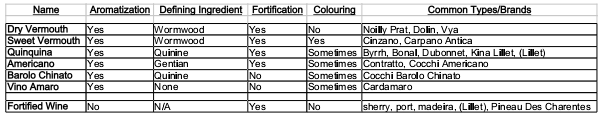


Because of the lack of clarification, some products end up in a sort of limbo between definitions. Lillet is an excellent example. Many bartenders call it a vermouth, but because it does not contain wormwood, it is not a vermouth by traditional definition. More importantly, Lillet is not aromatized, but rather a Bordeaux wine blend (85%) fortified with citrus liqueurs (15%), which themselves have been aromatized. This technically makes Lillet a fortified wine but not an aromatized one. Lillet was originally called Kina Lillet until the recipe was changed in 1987, and did actually contain quinine, so originally Lillet would be considered a quinquina. Today's recipe claims to still contain quinine, but this is neither confirmed nor evident. Cocchi Americano, which is supposedly a good approximation of Kina Lillet, contains gentian as a major component so is considered an americano (hence the name). 

Things are for the most part confusing, so while it is important to know the history and general distinctions between these types of wines, the most important factor is taste. Each of these products have their own place and use and should not always be used interchangeably. Most importantly of all, they are wines and need to be treated as such. They will go off over the course of a few days to a few weeks depending on the product, and should be kept in the fridge if stored.

Next post I will delve deeper into vermouth with more specific history and geography of the major brands.


 [[ originally published on www.shakestir.com by Rhett Williams ]]

Thursday, 20 December 2012

Winter Cocktails: Teardrop Lounge in Portland

Portland will be making its first appearance on this site today! Having finally been able to visit for my first time this year, I was blown away by the amount of great food and drink available (and also by the number of strip clubs, but that's not really relevant). The cocktails were consistently great, as was the coffee, and of course the prices (no tax is as fun as you think). Taking a tour down Distillery Road and seeing the impressive number of great spirits being made in one city was also exciting. House Spirits Distillery stood out to me in particular, with Krogstad aquavit and Aviation gin, and their delicious and fresh-tasting coffee liqueur. The number of high quality bars in the city is exciting as well, with Clyde Common, Kask, Rum Club, Beaker & Flask, The Driftwood Room, and Teardrop Lounge - just to name a few. It is with great pleasure that I am able to share some holiday drink recipes from the most latter of these names, one of the best bars in the U.S., the Teardrop Lounge.

Teardrop has an amazing program with a focus on fresh and high-quality ingredients, adopting as they say the "Golden Rule of the kitchen: the finished product relies entirely upon the quality of source ingredients." Their
diverse menu has a nice collection of original drinks, obscure classics, and those made by friends in other renowned bars. Each of the three menus offer a punch for the table, an excellent and fun way to start your drinking evening.

Bartender and co-owner Daniel Shoemaker has graciously contributed a total of four holiday drinks along with recipes. I will separate these into two separate posts for easier absorption.

First up is the Long Time Coming, a pisco-based cocktail with three house-made ingredients: a cherry digestif, a port redux, and truffle bitters. Daniel shares his recipes for each of these ingredients below, and I hope you find them as creatively inspiring as I do!
Following that is the Humble Pie, a mix of blended Scotch and applejack with Christmas spice flavours like pimento, ginger, and peppercorn.

Long Time Coming
2 oz Campo de Encanto pisco
¾ oz Cherry Digestif*
½ oz Port Reduction*
8 drops Truffle bitters*

Stir with ice, strain into a chilled cocktail glass.  
No garnish.  

*Cherry Digestif
8 Quart cherry pits, topped with GNS, stored in cool place for 1 month, agitated daily.  Strain, add:
40 g dandelion root, toasted                                                
15 g gentian, toasted
40 g cedar chips, toasted                                    
8 g rhubarb root, toasted
40 g dong quoi                                                            
3 g horehound
15 g Cherry Bark                   
Steep all ingredients for an additional 24-36 hours.  
Strain, bottle.

*Port Redux
750ml Ruby port
1/4 oz cane sugar
6 cloves
2 star anise
15 green cardamom pods
1 Indonesian cinnamon sticks, crushed
Bring all ingredients to a light simmer, stirring occasionally until total liquid has reduced by 1/3.  
Allow to cool to room temperature, strain & bottle.

*Truffle Bitters
1 lb unsalted butter
½ oz Oregon black truffles
2 – 750 ml high-proof rye
½ cup toasted quassia
1/8 cup rose hips
1/8 cup sweet orange peel
1 tablespoon grains of paradise
1 tablespoon angelica
1 teaspoon fennel seed
1 teaspoon cumin seed
Clarify butter in heavy-bottomed saucepan at low heat for 1 hour.  Remove from heat, pour over thinly sliced truffles.  Let steep for 1 hour.  Strain through sieve into large, non-reactive container.  Pour rye in with butter, let steep airtight for 6 weeks. Freeze overnight to let separate. Strain off butter & all solids, returning rye to container. Add rose hips, orange peel, & qussia. Let steep for 10 days.  Add remaining spices & seasonings, let steep for 3 more days. Strain, add 1 tablespoon caramelized sugar syrup. Pour through funnel into oak barrel (treated with fine sherry for previous 6 weeks). Let age for 3 months. Strain, filter through brita filter & bottle.

Humble Pie
1 oz Laird's bonded applejack
1 oz Famous Grouse blended scotch
1/4 oz ginger syrup (2:1)
1 teaspoon rich demerara syrup (2:1)
4 dashes pimento dram
1 dash Angostura bitters
2 grinds black peppercorn
Candied ginger
Stir all ingredients with ice, strain over a large ice cube in a  rocks glass.  
Garnish with a piece of candied ginger on a small skewer. 


Stay tuned later tonight for two more holiday recipes from the Teardrop Lounge!


More Holiday Drinks!
[[ Teardrop Lounge Part 2 ]]

Sunday, 16 December 2012

Winter Cocktails: "Cold & Delicious" from The Violet Hour in Chicago

Now that we've seen some history on eggnog, we can try some modern variations. Today's contribution is from a new bar and a new city to the site: The Violet Hour in Chicago. Touting not only a sophisticated and solid cocktail menu and program, the design of the place itself is designed to showcase a partitioned bar and the bartenders themselves. As they explain on their site, "the early 19th century English club and French salon were the beginning of the modern venue for socializing and drinking" and the space takes inspiration from this era. It uses partitions and high wing back furniture to "create places of intimacy conducive to the art of conversation."

The house rules include not only wearing proper attire, but refraining from cell-phone use and serving Jager-bombs, Grey Goose, and light beer. Drinks for the most part showcase the flavours of the spirits, while using interesting bitters (like Root Beer), amari (like Abano), and the occasional fruit syrup and preserves.

I'm excited to have such a great establishment from such a beautiful city contributing to the site this winter. Bar manager Robert Haynes has passed along The Violet Hour recipe for their "easy and fun alternative to the bad eggnog that permeates the holiday season." Sticking with a more English-style, they adopt Cognac and port but also add Christmas spices, walnut, and apple flavours to the mix.

Cold & Delicious
2oz Pierre Ferrand 1840 Cognac
3/4oz Dow's Ruby Port
1/2oz Spice Trader Syrup
1/4oz Nux Alpina Walnut Liqueur
9 drops House-made Apple Bitters
1 whole egg

Combine all ingredients in a shaker. 
Shake vigorously to incorporate egg. 
Add ice, shake and strain into a rocks glass. 
Top with grated cinnamon. 

Spice Trader syrup: 2:1 demerara syrup. While heating the sugar/water add a small handful of blade mace, cardamom, and vanilla. Let simmer for 10 minutes, then strain and cool. 

As for the apple bitters, there are some available, but making bitters at home is not as complicated as one might think. I'm currently tweaking my own apple bitters recipe, which I plan on sharing here in the near future. The idea behind any bitters recipe is simply to steep herbs and bittering agents in a high-proof alcohol. That makes it sound a lot easier than it is, but experimentation is the fun of the process.

Thanks to Robert and The Violet Hour! Cheers!

More Holiday Drinks!
[["Yukon Cornelius" from Veneto in Victoria ]]
[[ "The Rockefeller" from Veneto in Victoria ]]
[[ The Hot Toddy ]]
[[ Winter drinks from Smuggler's Cove in San Francisco ]]
[[ "Bear Skin" from The Refinery in Vancouver ]]
[[ "Cold & Delicious" from The Violet Hour in Chicago ]]
[[ The history of Eggnog ]]
[[ "Gold," "Frankincense," and "Myrrh" from Trevor Kallies in Vancouver ]]
[[ "Old Saint Juan" from Shea Hogan in Vancouver ]]
[[ "Hot Buttered Rhum Cider" from Slanted Door in San Francisco ]]
[[ The history of mulled wine ]]
[[ The history of The Flip ]]
[[ Hot Buttered Rum ]]

Thursday, 6 December 2012

Winter Cocktails: Mulled Wine & Cider (Glögg, Glühwein, & Wassail)

Opening the door to a discussion of mulled wine would result in hours of debate and anecdote, (made all the more difficult if simultaneously consuming said wine). This can be proved simply by listing even a handful of its names and variations: Glühwein, Glögg/Gløgg, vin chaud, greyano vino, izvar, Glintwein, Caribou, Hippocras, Negus, and Feuerzangenbowle. It can have different bases, such as port (called a "Smoking Bishop"), ginger wine and raisins ("Smoking Beadle"), or Champagne ("Smoking Cardinal"). Then there are the mulled ciders, ales, and meads, and the close relation to punch, bringing with it further wealth of history and variation. The number of cultures with a version of this theme is mind-boggling, but the purpose behind the practice is consistently the same.

Before proper storage techniques were invented, food and drink spoiled fairly quickly. One had to be creative to keep food fresh longer or at least to make stale and spoiling food more tolerable (practices that also masked poor-quality products). In Roman times, spices and sugars or honey were added to wines to delay spoilage or mask flavours, typically a practice done in the early winter once the wines harvested in early fall began to stale. This practice dates back to Greece as well, where a wine, spice, and honey mixture called "Hippocras" or "Hypocrace" (supposedly created by Hippocrates as a health tonic) was used and later became popular England for the next thousand years. Other cultures figured out similar strategies for wines and juices and as years passed practical process became tradition.

In Southern England where apples and cider (fermented fruit juice) were an important part of agriculture, a yearly autumn ritual was created sometime before the 11th century called "Wassailing." This was a ceremony celebrated in early January involving drink and song that blessed the health of the trees, scared away evil spirits, and ensured a good harvest for the following autumn. (Wassailing was also a traditional exchange between lords and peasants in the middle ages that encouraged charity, which is the origin of what we consider Christmas Caroling, but has no direct relation to drinking). The drink for this ceremony was aptly named the "Wassail," a heated ale (and later cider) mulled with sugar, cinnamon, ginger, nutmeg, and sometimes fruit, brandy, sherry, and even bread.

By the 18th century, most cultures had a solid tradition and recipe for mulled wine. We will only look at a few of the most popular here: Glühwein and Glögg (pronounced "gloo-vine" and "gluig"). While similar, the differences in alcohol, spice, and garnish are very important to those who carry the tradition. Every town has its own secret recipe, so I am amalgamating the ones I've come across as there are several consistencies. The one thing I don't like in my mulled wine is fruit juice, and this doesn't show up very often save for more modern North American versions. It's not necessary and mutes the spice.

Glühwein (German Mulled Wine, dating to early 15th century)
1 bottle of dry red wine (750ml)
1/2 cup of sugar
1/2 lemon or orange, sliced
10 whole cloves
3-5 cinnamon sticks


Pour the wine into a large pot and add other ingredients. Simmer at low heat (do not boil) for 30-60 minutes and serve.
There are MANY options here, including adding some allspice berries, maybe a 1/2 teaspoon of ground nutmeg, and adding some water should you simmer the wine too long or too hot, which will make it thick and syrupy.
Serve in warmed mugs, and optionally add an ounce of brandy to make things interesting. Do not add the brandy to the heated mixture as the alcohol will boil off.

(Feuerzangenbowle is a Glühwein that leaves a sugarloaf soaked in rum then set aflame sitting atop the wine, slowly dripping sugar into the mix.)

Glögg (Nordic Mulled Wine dating to early 17th century)
1 bottle of dry red wine
1 bottle of port
[2 cups brandy (optionally akvavit or vodka)]
2 cups water
1 peel of orange (the whole orange), cut into strips
10 cardamom pods or about 1/2 tsp of cardamom seeds
10 whole cloves
1/2 cup raisins
1/2 cup blanched almonds
1 cup sugar (or less to taste)
2 cinnamon sticks
3-5 slices of peeled ginger (optional)


Processes consistently differ, with some boiling the brandy with sugar to create a syrup with which to sweeten the mulled wine and port mixture. Myself, I prefer the highest alcohol content and flavour possible in my drinks, so I prefer to add the brandy last to each mug before serving, as with the Glühwein. The 2 cups of brandy above is a measurement if combining it to the wine mixture while heating, but if you choose not to do this as I have, just measure 1-2oz of brandy per mug before serving. Having said that, here the best process:
Combine wine, port, water, orange peel, cardamom, cloves, sugar (start with 1/2 cup), cinnamon, and ginger in a pot and simmer at low heat for 10 minutes. Add more sugar to taste. At this point you can optionally let the mixture cool and have it steep in the fridge overnight before reheating to maximize the flavour. For those of you like me who are less patient, keep the mixture at low heat for another 20 minutes or so, being careful not to boil. Prepare 10 mugs by warming them and dishing out about 1tsp of almonds and raisins to each, along with the brandy if not used in the first step. Strain mulled wine into each mug and garnish optionally with a fresh orange zest or whole clove (or better yet, an orange zest with a whole clove stabbed into it).
To be further adventurous, you can soak the almonds and raisins beforehand in a mixture of spice and akvavit. Leave them in a sealed bag or container for at least 24 hours with some cardamom seeds, cloves, and cinnamon, and enough akvavit to ensure they're covered. Even just soaking in the akvavit will extract a surprising amount of flavour from the spirit, which includes caraway, cardamom, cumin, anise, fennel, and citrus. For anyone not accustomed the flavour of this spirit, soaking the raisins and nuts and adding them to the mug when served is a subtle and fancy addition of the flavour.

Mulled cider is another very common and fitting winter drink (and is synonymous with Wassail today). I feel it would be redundant to list a recipe here. Following either of the above mulled wine recipes or variations thereof would work just fine if cider is substituted for the wine and the sugar is omitted. For all three drinks, other spices that would make great additions include a little nutmeg, whole star anise, allspice berries, and a few slices of citrus. Broken cinnamon bark can be used in place of cinnamon sticks, though use it more sparingly as it has higher surface area. I again stress that adding the spirit while serving and not while steeping is a better option to ensure full flavour and alcohol.

[["Yukon Cornelius" from Veneto in Victoria ]]
[[ "The Rockefeller" from Veneto in Victoria ]]
[[ The Hot Toddy ]]
[[ Winter drinks from Smuggler's Cove in San Francisco ]]
[[ "Bear Skin" from The Refinery in Vancouver ]]
[[ "Cold & Delicious" from The Violet Hour in Chicago ]]
[[ The history of Eggnog ]]
[[ "Gold," "Frankincense," and "Myrrh" from Trevor Kallies in Vancouver ]]
[[ "Old Saint Juan" from Shea Hogan in Vancouver ]]
[[ "Hot Buttered Rhum Cider" from Slanted Door in San Francisco ]]
[[ The history of mulled wine ]]
[[ The history of The Flip ]]
[[ Hot Buttered Rum ]]

Friday, 19 October 2012

Fall Cocktails: "Jones' Bitter Aperitif" by Evelyn Chick

Next up is the always creative and lovely Evelyn Chick, who previously contributed to the Bittered Sling series in the summer (which you can see here). Now you can catch her at the Blue Water Cafe in Yaletown of Vancouver.

Evelyn is sharing a unique cocktail combining some unsuspected elements, namely amaro and sparkling wine. Both port and allspice make appearances, lending some harvest flavour to the mix and further complexifying (yes, I just used that word) the herbal depth of the amaro combination. Caramel and coffee play with artichoke and bitter herbs and are balanced nicely by the dried fruit flavours from the port and the mulling spices of the syrup. Evelyn introduces it herself:

"This is the best way to make bubbles winter-appropriate. There was once the infamous Mr. Jay Jones sitting at my bar asking for something "bitter and bright," and immediately the challenge comes with how I can make two conflicting concepts work - bringing in 3 different types of herbaceous ingredients to balance out a light, bone-dry cava. It's the perfect aperitif, and the perfect after-dinner drink. Bon apetite!"

Jones' Bitter Aperitif

1/2oz Amaro Averna
1/4oz Cynar
1/4oz Taylor 10 Tawny Port
Barspoon All-Spice Syrup
Stir all ingredients with ice, strain into champagne flute & top with dry cava 

(Segura Veudas Brut Reserva used in photo)

All-Spice Syrup:
Boil a tablespoon of crushed allspice berries, one stick of cinnamon, and three cloves in one litre of water. Simmer for 15 minutes on low, then add two litres of sugar. Stir until dissolved, then let cool before bottling.


[[ Photography by Evelyn Chick ]]

The Fall Cocktail Series
You can see the series introduction here
and more terrible Halloween cocktails here
"Death & Oranges" by Donnie Wheeler
"The Satchmo" by Simon Ogden 
"Dark City" by Jay Jones
Classic Halloween Cocktails
"The Giant Huntsman" by Lauren Mote
"The Bay Harbour Butcher" by Shaun Layton  
"A Nightmare On Juniper Street" by Shea Hogan 

Thursday, 19 July 2012

"The Fellini" from Joel Virginillo at The Refinery

There’s something special about The Refinery. It could be the tasty Italian-influenced bites courtesy of chef Kirk Morrison, the very affordable prices, the talent behind the bar, or maybe its location on downtown Granville Street – an area known for nightclubs and not for quality food and drink. Maybe it’s the fun events hosted here weekly dating back to Lauren Mote’s Cocktail Kitchen, to the Mad Hatter’s Tea Party Wednesdays, to the Cork & Distillery Four Course Dinners starting this month. Or perhaps it’s the culinary approach that the bar takes to the cocktails and the dedication that they have to making everything fresh and in-house rather than stocking an extensive back bar. Looking past the wells you’ll see counters covered in hand-labeled mystery liquids, and around the restaurant itself are a multitude of shelves displaying mason jars of tinctures, bitters, infusions, preserves, teas, and herbs. Most bars nowadays have the occasional housemade bitters or flavoured syrups, but The Refinery takes this to a whole new level.

Chatting with bar manager Joel Virginillo reveals a passionate interest in all aspects of flavour and an ambition to combine them.

How do you view the cocktail program at The Refinery?
“The spirits we have here are selective – it’s the bitters and tinctures that are really the personality. Customers are getting more used to saying ‘I like this flavour but not this flavour’, and then we create something special for them. Something that sets us apart here is how we really nurture that – that’s what drew me to this place. Being able to take any random number of ingredients and throw something together that’s quality is really exciting. The most pleasure I get is from that culinary background of being able to create something individual for a specific guest.”

Where does that culinary approach come from for you?
“I actually started in the kitchen and studied at the Dubrulle French Culinary Institute when I was fifteen and afterwards had the chance to work with some amazing chefs. After that I went to a bartending school and actually ended up teaching there for five years before doing some consulting for nightclubs and it just went from there.”

How do you view the use of bitters and tinctures behind the bar?
“I like having a lot of options for flavour, and I’m also looking at the apothecary side of it and the health benefits of the ingredients I use. I definitely got inspiration from both Lauren and Dani (Tatarin from The Keefer) in that respect. Bitters, and for the most part the entire cocktail culture came from the medicinal side of things, and one day I want to create my own line of fairly profound bitters that have immediate health benefits. My ideal bar would have little vials and containers covering the entire back wall with raw teas, spices, nuts, and all this stuff – having that as part of the bar kit and almost replacing the back bar.”

Where do you think cocktail culture is going overall?
“The industry is really turning towards the personal relationship between the creators and the guests. Ten years ago it was pretty rare that anyone would care who the chef is at a restaurant, now you seek these people out and want to talk to them, and that’s now translating to the front of house and bartenders. Media has brought a lot of light to chefs and what it really means to be a professional in the flavour industry.
I think this ties into the economy right now too – people want a lot more quality for a lot less money, and a whole lot more feeling and story behind it. They want to know that they’re getting the most out of their dollar. People are going to a specific bar to meet a specific bartender for a special experience. There’s so much more to that than just going to a chain restaurant and getting a squishy out of a machine.
People’s palates and tastes have really changed too and everyone is really expecting quality now.”

Where do you see Vancouver’s cocktail culture going?
“Vancouver has the attention span of a gerbil. It’s so hard to tell where the trends are going, and while I like hearing what other bartenders are doing, I don’t pay a lot of attention and follow trends. I do what I’m interested in.”

How do you approach creating a new drink?
“I love changing people’s perceptions of something. Mixing with interesting spirits that aren’t overly common is one of my new interests, like pisco or grappa. Using good bases and having a ton of options. I definitely play with flavours in the spirit, but I also try to do a lot of things regionally – things that grow together tend to work really well together. A lot of our cocktails have classic origins, but we’ve taken them and done our thing. Any good bartender has to pay credit to classic cocktails.”

What cocktail have you chosen to share today?
It’s one that showcases our cocktail program, our Italian mentality, and what we do here. It’s sort of a classic cocktail with a little flare. There was a guy I knew was on a sherry kick, saying that port and sherry aren’t in cocktails enough, so when he came in I knew I wanted to start with that. Using a grape spirit base makes sense since the port is also grape-based, so grappa should work well, and we do a wicked grape bitter. The combination was very light, so adding Cynar gave it that herbaceous depth. I called it “The Fellini,” after the influential Italian filmmaker.

Originally posted on www.eatmagazine.ca by Rhett Williams
Photography by Rhett Williams: "The Fellini" by Joel Virginillo at The Refinery, Vancouver, 2012

The Fellini

1oz grappa
1/2oz Cynar
1/2oz Tawny Port
Dash of The Refinery’s grape bitters

Combine ingredients with ice. Stir. Strain over rocks.
Flame an orange peel over the drink and garnish.